



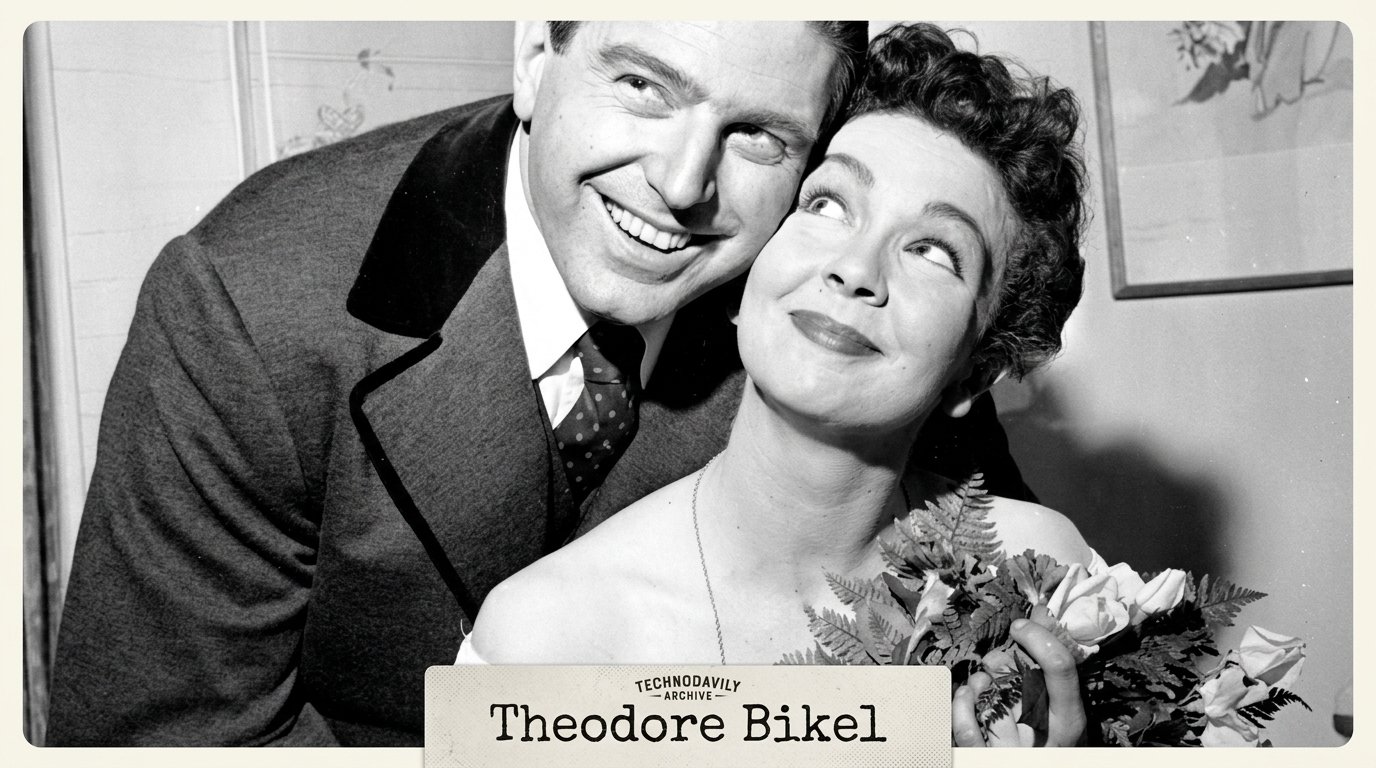
Theodore Bikel died in 2015 at age 91, and yet his name still gets searched every week — by theater fans, folk music collectors, Jewish history readers, and people who just watched Fiddler on the Roof for the first time and want to know who he was. Few performers moved between film, Broadway, folk music, and union leadership the way he did, and that range is exactly why his story keeps resurfacing.
This piece covers his life in order: where he came from, how he broke into acting, why Tevye became inseparable from his name, his parallel career as a folk singer, his role in Jewish and Yiddish cultural life, his years leading actors’ unions, and what he left behind.
Early Life and Escape from Vienna Theodore Bikel
Theodore Meir Bikel was born on May 2, 1924, in Vienna, Austria, to Miriam and Josef Bikel. His parents named him after Theodor Herzl, the founder of modern political Zionism — a detail that says something about the household he grew up in.
That household didn’t stay in Vienna long. After Nazi Germany annexed Austria in 1938, the Bikel family fled to Mandatory Palestine. Bikel was a teenager in a new country, and he started acting almost immediately. In 1943, at 19, he made his stage debut as the Village Clerk in a production called Tevye the Milkman at the Habimah Theater in Tel Aviv — a small, easy-to-miss detail that turns out to matter, because Tevye the Milkman is the same source material Sholem Aleichem later inspired Fiddler on the Roof from. Bikel played a small part in that story more than two decades before he’d become identified with its lead character for the rest of his life.
Break Into Acting
In 1946, Bikel left Palestine for London to study at the Royal Academy of Dramatic Art. Two years later, he landed his first professional credit — understudying both Stanley Kowalski and Mitch in the West End premiere of Tennessee Williams’ A Streetcar Named Desire. When he got his chance to go on, he played opposite Vivien Leigh in a production directed by Laurence Olivier.
His film career picked up from there. He appeared in The African Queen (1951) and, later, My Fair Lady (1964). His most significant early recognition came in 1958, when he received an Academy Award nomination for Best Supporting Actor for playing a Southern sheriff in The Defiant Ones, the drama about two escaped prisoners — one Black, one white — chained together. Over his career he appeared in more than 150 films, along with guest roles on television shows including Mission: Impossible, Hawaii Five-O, Charlie’s Angels, and Ironside. Younger audiences may know him best from a very different role: he played a Klingon foster father on Star Trek: The Next Generation.
Broadway and Tevye
Bikel made his Broadway debut in 1955 in Tonight in Samarkand. In 1958 he earned his first Tony nomination for The Rope Dancers. A year later, he created the role of Captain Georg von Trapp in the original 1959 Broadway production of The Sound of Music — the role earned him a second Tony nomination, and he was reportedly the performer for whom Rodgers and Hammerstein wrote “Edelweiss,” the last song Oscar Hammerstein II ever completed before his death.
But it’s his other role that defines his legacy. Bikel did not appear in the original 1964 Broadway production of Fiddler on the Roof, nor in the 1971 film — that part went to Zero Mostel and Chaim Topol, respectively. Bikel took over the role of Tevye on Broadway in 1967, and from that point on, he made it his own. He went on to play Tevye more than 2,000 times over more than four decades, including stepping into a North American touring production in 2010 at age 86 when Topol had to withdraw due to injury. No other actor has played Tevye as many times as Bikel did.
Folk Music Career
While building his acting résumé, Bikel was also becoming one of the more prolific folk musicians of his era. He recorded 37 albums across his lifetime, singing in multiple languages — he was fluent in seven — and performed alongside artists like Pete Seeger and The Weavers.
In 1959, Bikel was one of the founders of the Newport Folk Festival, which went on to become one of the defining events of the American folk revival and helped launch the careers of numerous musicians over the following decades. His involvement placed him at the center of a music movement that, in the 1960s, overlapped heavily with civil rights activism and political folk music — a connection Bikel leaned into for the rest of his career.
Jewish Identity and Yiddish Culture
Bikel’s connection to Jewish and Yiddish culture ran through nearly everything he did. He recorded extensively in Yiddish and Hebrew, performed traditional Jewish folk songs throughout his touring career, and wrote and starred in Sholom Aleichem: Laughter Through Tears, a stage production about the Yiddish author whose stories inspired Fiddler on the Roof. It premiered in Washington, D.C., in 2008. His last film project was a documentary about interpreting Sholem Aleichem’s writing.
For Jewish audiences, Bikel wasn’t just an actor who happened to play a Jewish character — he spent decades actively preserving and performing Yiddish-language music and theater at a time when that culture was in real danger of fading from public life.
Activism and Industry Leadership
Bikel’s public life extended well past acting. He was active in the American civil rights movement and remained politically engaged for the rest of his life. Within his own industry, he served as president of Actors’ Equity Association in the late 1970s and early 1980s, and later became president of the Associated Actors and Artistes of America, the umbrella federation covering performing arts unions including Actors’ Equity and the Screen Actors Guild.
That combination — headline performer and union leader — was unusual even among his peers, and it’s a big part of why labor historians and theater-industry readers still bring up his name.
Later Life and Legacy
Bikel kept working into his late 80s, including that 2010 return to Tevye on tour. He became a U.S. citizen in 1961 and received a star on the Hollywood Walk of Fame in 2005, at age 80, with fellow actors Martin Landau and Ed Asner attending the ceremony.
He died on July 21, 2015, in Los Angeles, at 91, of natural causes. Tributes at the time noted the same thing this article has tried to lay out: that no single label — actor, singer, activist, union leader — fully covered what he did across seven decades of public life.
Conculsion
Theodore Bikel’s career resists a single label because he refused to stay in one lane. He was a working film actor for over 60 years, the actor most identified with two of Broadway’s most enduring musicals, a folk musician with dozens of albums to his name, a co-founder of one of the most important festivals in American music history, and a union president who spent years on the practical, unglamorous work of representing performers. For film buffs he’s the man who lost to David Niven at the Oscars but kept working for another five decades. For folk fans he’s a Newport Folk Festival founder standing next to Pete Seeger. For Jewish audiences he’s one of the last major public figures to actively carry Yiddish theater and music into the mainstream. Those aren’t separate legacies — they’re one career, and it’s why his name still turns up in so many different searches nearly a decade after his death.
Frequently Asked Questions
How many times did Theodore Bikel play Tevye in Fiddler on the Roof? More than 2,000 times, from 1967 to 2010 — more performances of the role than any other actor, including Zero Mostel and Chaim Topol, who originated it on Broadway and in film respectively.
Was Theodore Bikel in the original Fiddler on the Roof cast? No. Zero Mostel originated Tevye on Broadway in 1964, and Chaim Topol played the role in the 1971 film. Bikel took over the stage role in 1967 and went on to play it more than anyone else.
What was Theodore Bikel nominated for an Oscar for? He received a Best Supporting Actor nomination in 1958 for his role as a Southern sheriff in The Defiant Ones.
Did Theodore Bikel originate a role in The Sound of Music? Yes. He created the role of Captain Georg von Trapp in the original 1959 Broadway production, a performance that earned him a Tony nomination.
What did Theodore Bikel do besides acting? He was a folk singer who recorded 37 albums, a co-founder of the Newport Folk Festival, a civil rights activist, and president of both Actors’ Equity Association and the Associated Actors and Artistes of America.
