



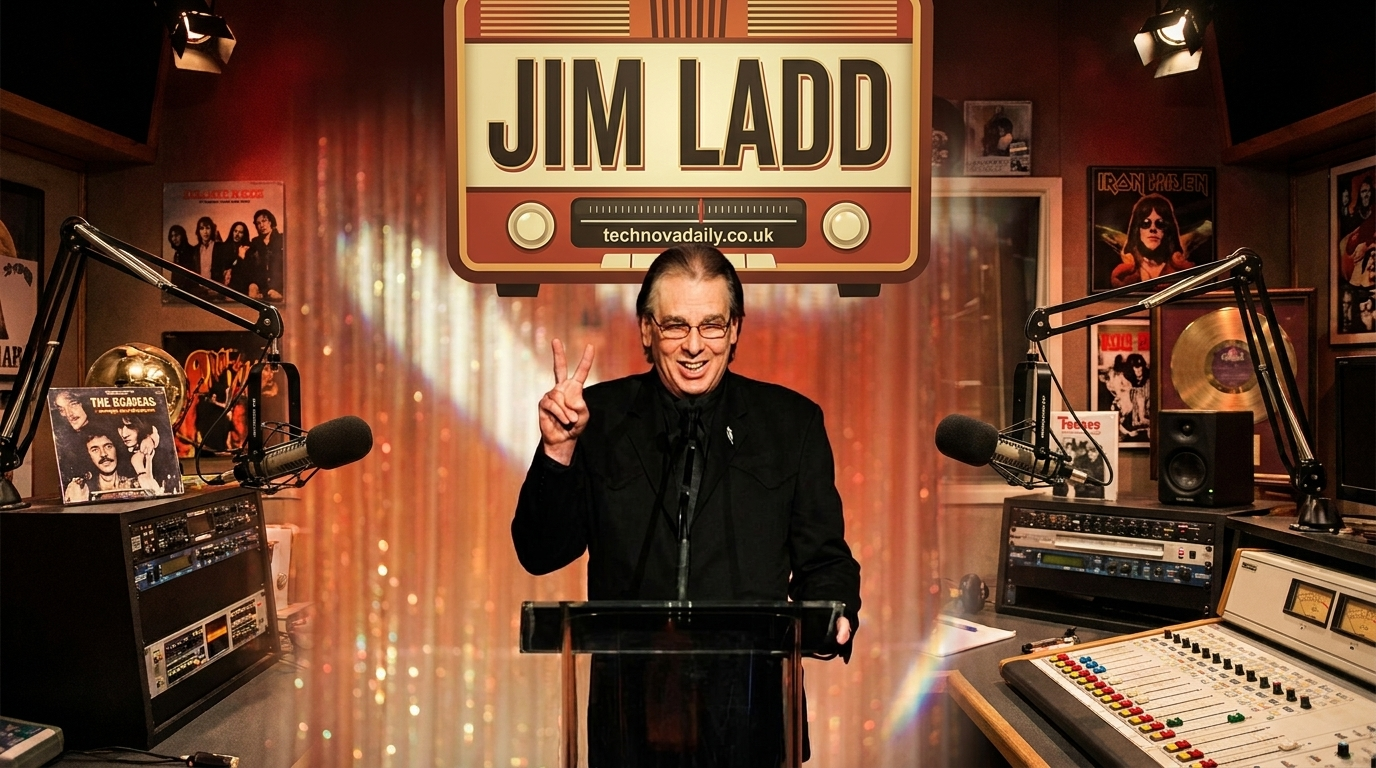
Jim Ladd was an American disc jockey, radio producer, and writer who spent more than five decades on Los Angeles airwaves, and he is widely remembered as one of the last true free-form rock DJs in U.S. commercial radio. Born James William Ladd on January 17, 1948, in Lynwood, California, he died on December 17, 2023, at age 75, after suffering a heart attack. Over his career, Ladd worked at KNAC, KMET, KLOS, and later SiriusXM, building a reputation for picking every song on his show himself, at a time when most stations had already handed that decision to corporate playlists.
This piece covers his early career, his signature shows, his ties to Pink Floyd and Tom Petty, and why his death marked the symbolic end of an era in American radio.
Who Was Jim Ladd? A Quick Answer
Jim Ladd was a Los Angeles-based rock radio DJ best known for hosting the nationally syndicated interview show InnerView, for his decades-long run on KMET and KLOS, and for his friendship with Pink Floyd’s Roger Waters, who cast him as a rebel DJ on the 1987 album Radio K.A.O.S. Tom Petty is widely believed to have written “The Last DJ” (2002) about Ladd, honoring his refusal to let record labels or station managers dictate his playlists.Jim Ladd
Early Life and Career Beginnings
Ladd grew up in Lynwood, California, and entered radio in 1969, taking the overnight shift at KNAC, a small Long Beach station that had just switched to an underground rock format. This was the peak of free-form FM radio, a style where DJs built entire sets around mood, theme, or story rather than following a fixed rotation handed down by management.
That early training at KNAC shaped how Ladd approached every show for the rest of his career. Rather than reading from a station-approved list, he treated each broadcast as a piece of storytelling, threading songs together around a theme, a mood, or current events.
Rise to Prominence at KMET and KLOS
Two years after joining KNAC, Ladd moved to KLOS in Los Angeles, then joined KMET in 1974, where he stayed for roughly a decade. During this stretch, he was named Los Angeles’ top FM DJ in the late 1970s and early 1980s, a period widely considered the high point of album-oriented rock radio in Southern California.
What set Ladd apart from most of his peers was creative control. Station management at KLOS gave him full authority over his own show content, letting him combine music with sound effects, spoken-word segments, and social commentary. He often built entire sets around a single theme, such as outlaws, fast cars, or particular artists, and regularly folded listener requests directly into those sets on the air.
InnerView and Headsets: His Signature Shows
Ladd’s most influential project was InnerView, an hour-long syndicated program he created and hosted starting in the mid-1970s. At its peak, the show aired weekly on more than 160 stations across the country between 1974 and 1986, making it one of the first nationally distributed artist-interview formats in rock radio.
InnerView gave listeners an in-depth look at music from the artist’s own point of view rather than a label’s marketing angle. Over its run, Ladd sat down with some of the biggest names in rock, including:
- Led Zeppelin
- John Lennon
- Pink Floyd
- The Beach Boys
- The Bee Gees
- Aerosmith
- Stevie Nicks
- U2
- Joni Mitchell
- Eagles
He later created a second nationally syndicated program, Headsets, continuing the thematic, story-driven format that became his trademark, often punctuated by his signature catchphrase, “Lord have mercy!”
Connection to Pink Floyd and Roger Waters
Ladd’s on-air persona eventually crossed into the world of recorded music itself. Pink Floyd’s Roger Waters, a longtime friend, invited him to take part in the 1987 concept album Radio K.A.O.S., where Ladd played a rebel DJ character. The role extended beyond the studio: Ladd joined Waters on the album’s world tour and appeared in three music videos connected to the project.
That collaboration reflected something artists across rock music recognized in Ladd: he was one of the few DJs treated as a peer rather than a promotional gatekeeper.
The Tom Petty Connection: “The Last DJ”
One of the clearest signs of Ladd’s standing in the industry came from Tom Petty. In 2002, Petty and the Heartbreakers released the song and album The Last DJ, widely reported to have been inspired by Ladd and his refusal to compromise his playlists for corporate radio interests. The song became a protest anthem against the consolidation of American radio in the 1990s and early 2000s, a period when large ownership groups bought up local stations and replaced personality-driven programming with centralized, research-tested playlists.
For fans of free-form radio, “The Last DJ” cemented Ladd’s reputation as a symbol of resistance to that shift, a DJ who kept picking his own songs long after most stations stopped allowing it.
Career at SiriusXM
After leaving KLOS in 2011, when new ownership under Cumulus Media took over the station, Ladd was quickly picked up by SiriusXM. He joined the satellite service in January 2012 to host a live, daily, free-form show on the Deep Tracks channel, a station built around album-oriented rock.
The move let Ladd continue the format he’d spent his entire career defending, at a time when terrestrial radio had largely abandoned it. His SiriusXM show ran until his death in December 2023, making him one of the last DJs in the country still building live sets around personal choice rather than an algorithm or a corporate playlist.
Personal Life and Legacy
In 1991, Ladd published his memoir, Radio Waves: Life and Revolution on the FM Dial, documenting his years as a top Los Angeles rock DJ and the corporate takeover of his station that reshaped the industry around him.
His work reached beyond radio as well. He played an all-night DJ in the film Say Anything, and his music selections appeared in movies including Tequila Sunrise, Rush, She’s Out of Control, and Defendor.
Ladd received several honors over his career, including Air Personality of the Year from the Los Angeles Music Awards in 2000, the Hollywood Arts Council’s Media Arts Award in 2007, and a star on the Hollywood Walk of Fame in May 2005. He lived in the Hollywood Hills and is survived by his wife, writer and musician Helene Hodge-Ladd.
Death and Tributes
Jim Ladd died late on the night of December 16, 2023, after suffering a heart attack, with his passing announced the following day by his SiriusXM colleague Meg Griffin during the time slot of his own weekly show. He was 75.
Tributes followed from across the music industry. The Doors’ drummer John Densmore and guitarist Robby Krieger both spoke publicly about their long friendship with Ladd, with Krieger calling him one of the best friends The Doors ever had in radio, crediting him with continuing to play the band’s music even during periods when mainstream attention had moved on. Flowers were placed on his Hollywood Walk of Fame star days after his death.
Why Jim Ladd Still Matters to Radio Today
Ladd’s career spanned the exact period when American radio changed from a personality-driven medium into a data-driven one. He started at a small Long Beach station in 1969, when DJs regularly played entire album sides uninterrupted, and he ended his career on satellite radio in 2023, still choosing every song on his own show.
That consistency is why his name keeps coming up whenever people discuss what free-form radio actually meant, and why artists from Roger Waters to Tom Petty treated him less like a broadcaster and more like a collaborator. As algorithm-driven playlists and AI-generated recommendations take over more of how people discover music, Ladd’s decades-long insistence on picking his own songs stands as one of the clearest examples of what radio looked like before that shift happened.
Conclusion
Jim Ladd spent more than fifty years proving that a radio DJ could be more than a voice reading a corporate playlist. From his first overnight shift at KNAC in 1969 to his final broadcasts on SiriusXM in 2023, he kept building sets by hand, kept choosing artists over algorithms, and kept the free-form format alive long after most stations had abandoned it. That commitment earned him a star on the Hollywood Walk of Fame, a place in Tom Petty’s songwriting, and a role in Roger Waters’ Radio K.A.O.S., but his real legacy sits in what he represented: a radio personality who trusted his own judgment over a ratings spreadsheet. As streaming platforms and AI-driven recommendations take over most music discovery today, Jim Ladd’s career remains one of the clearest reminders of what radio sounded like when a single person, not a data model, decided what played next.
Frequently Asked Questions
Who was Jim Ladd? Jim Ladd was an American radio DJ, producer, and writer, known as one of the last free-form rock DJs in U.S. commercial radio. He worked at KNAC, KMET, KLOS, and SiriusXM over a career spanning more than 50 years.
When did Jim Ladd die? Jim Ladd died on December 17, 2023, at age 75, after suffering a heart attack.
What radio stations did Jim Ladd work at? Ladd worked at KNAC (Long Beach), KLOS, KMET, KMPC, and KLSX in Los Angeles, before joining SiriusXM’s Deep Tracks channel in 2012.
Is Tom Petty’s “The Last DJ” about Jim Ladd? Yes. Tom Petty’s 2002 song and album “The Last DJ” is widely reported to have been inspired by Jim Ladd, honoring his refusal to let corporate radio owners dictate his playlists.
What was Jim Ladd’s connection to Pink Floyd? Roger Waters invited Ladd to play a rebel DJ character on his 1987 album Radio K.A.O.S. Ladd also joined Waters’ world tour for the album and appeared in three related music videos.
What was InnerView? InnerView was a nationally syndicated interview show created and hosted by Jim Ladd, airing weekly on more than 160 stations between 1974 and 1986. It featured in-depth conversations with artists including Led Zeppelin, John Lennon, and Pink Floyd.
