



FSH levels can help explain changes in a woman’s hormones as she approaches menopause. FSH stands for follicle-stimulating hormone, which helps regulate the menstrual cycle and egg development. As ovarian function declines, FSH levels often rise.
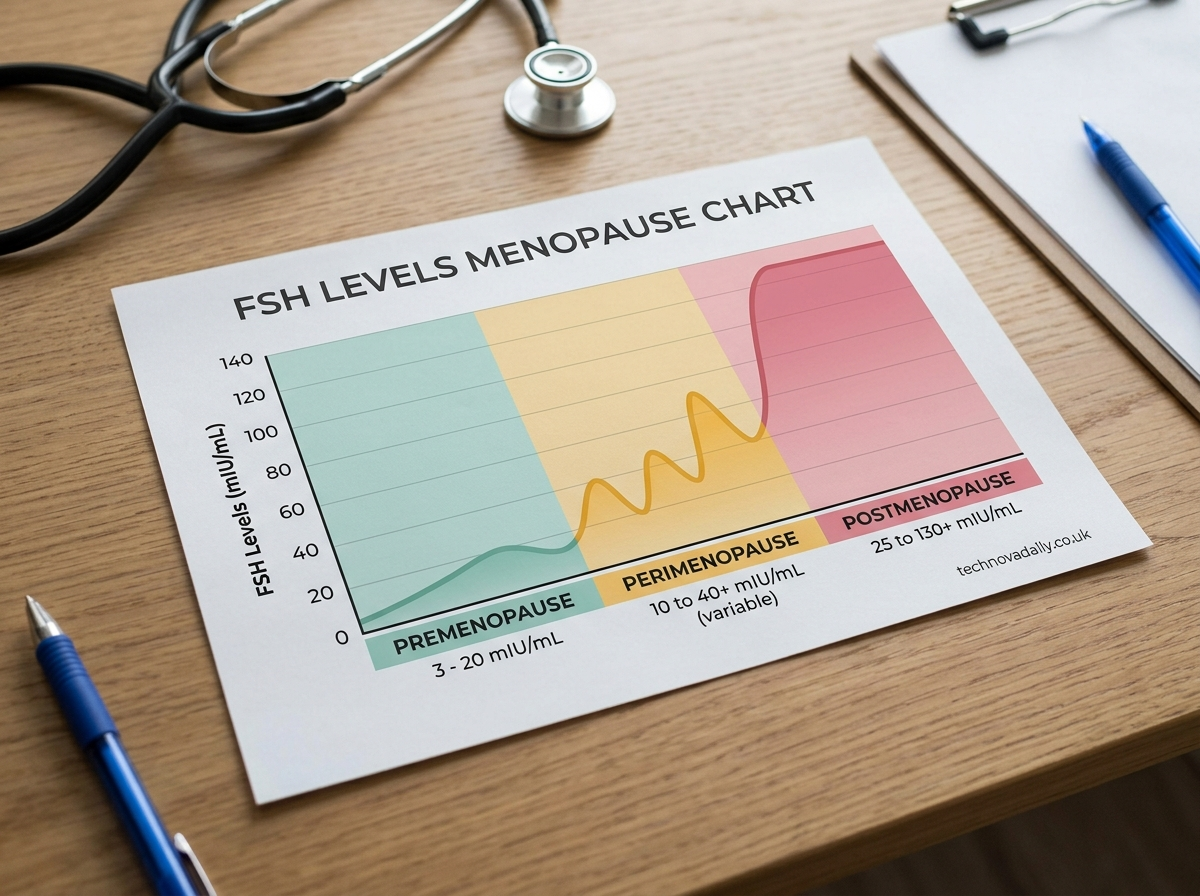
The FSH levels menopause chart below provides a general guide to understanding hormone test results before, during, and after menopause. However, there is no single FSH number that confirms menopause in every woman. Age, menstrual history, symptoms, medications, and the laboratory’s reference range all matter.
FSH Levels Menopause Chart
FSH is measured through a blood test, usually in international units per liter (IU/L) or milli-international units per milliliter (mIU/mL). These two units have the same numerical value for FSH.
| Reproductive stage | Example FSH range | What it may indicate |
|---|---|---|
| Before menopause | Changes with the menstrual cycle; roughly 3.5–21.5 IU/L across common cycle phases | Ovarian function and hormone levels vary throughout the month |
| Perimenopause | May fluctuate from normal reproductive levels to above 25 IU/L | The menopause transition may be underway |
| Menopause transition | FSH may be repeatedly elevated, sometimes above 30–40 IU/L | Reduced ovarian activity may be contributing to hormone changes |
| Postmenopause | One laboratory reference range is approximately 25.8–134.8 IU/L | Higher FSH is common after ovarian function declines |
These figures are general examples, not universal diagnostic cutoffs. The reference range on your own laboratory report should guide interpretation. FSH can change considerably during perimenopause, so one result may not reflect your usual hormone levels. Source: MedlinePlus
What Is FSH and Why Does It Rise During Menopause?
Follicle-stimulating hormone is produced by the pituitary gland, a small gland at the base of the brain. In women who have menstrual cycles, FSH helps stimulate the growth of ovarian follicles, which contain developing eggs.
The ovaries also produce estrogen. When ovarian function declines with age, the hormonal feedback that normally helps regulate FSH changes. The pituitary gland responds by releasing more FSH in an attempt to stimulate the ovaries.
This is why FSH levels often rise during the years leading up to menopause and remain elevated after menopause. However, hormone levels do not change at the same rate in every woman.
What FSH Level Indicates Menopause?
An FSH level above 25 IU/L may support the possibility that a woman is entering the menopause transition. Levels above 30 or 40 IU/L can also occur during this period or after menopause. However, these numbers should not be used alone to confirm that menstruation has permanently stopped.
For women aged 45 or older who have typical menopause symptoms and changes in their periods, clinicians generally identify perimenopause or menopause from symptoms and menstrual history rather than routine FSH testing. Menopause is usually defined as 12 consecutive months without a menstrual period, provided there is no other explanation and hormonal contraception is not affecting the assessment. Source: NICE menopause guidance
If you are younger than 45, particularly younger than 40, and your periods have become irregular or stopped, a healthcare professional may recommend hormone testing. Early menopause and premature ovarian insufficiency need appropriate assessment.
FSH Levels During Perimenopause
Perimenopause is the period when the body begins moving toward menopause. It often starts during the 40s, although the timing differs between individuals.
During this stage, ovarian hormone production becomes less predictable. FSH may be low or within a reproductive range on one day and higher on another. This explains why a single blood test may not match the symptoms a woman experiences.
Common signs of perimenopause include irregular periods, hot flashes, night sweats, trouble sleeping, mood changes, and vaginal dryness. Not everyone experiences the same symptoms, and other health conditions can cause similar changes.
If your FSH result is within the laboratory’s usual reproductive range, you may still be in perimenopause. Your clinician will consider your symptoms, age, menstrual pattern, and medical history rather than relying on one result.
FSH Levels Before Menopause vs. After Menopause
Before menopause, FSH changes during the menstrual cycle. Its level may rise around ovulation and vary during other parts of the cycle. A result that is normal at one point in the month may differ at another.
After menopause, FSH is usually higher because the ovaries produce less estrogen and provide less hormonal feedback to the pituitary gland. Some laboratory reference ranges for postmenopausal women start at approximately 25.8 IU/L, but the exact range depends on the test used.
Estrogen levels often decline during the menopause transition, while FSH tends to rise. Still, the two hormones do not always follow a fixed pattern. Hormone therapy and certain medications can also affect test results.
How to Read Your FSH Blood Test Results
Start by checking the FSH result, the units, and the reference range printed on your laboratory report. A result marked high means it is above that laboratory’s comparison range; it does not automatically mean you have reached menopause.
Next, consider when the sample was taken. If you still have periods, FSH can vary according to the stage of your menstrual cycle. Your clinician may ask about the date of your last period, changes in cycle length, and any symptoms you have noticed.
Medication history also matters. Hormonal contraception and hormone therapy can affect FSH measurements or make them harder to interpret. Depending on your situation, your clinician may recommend repeat testing or other investigations. Do not stop prescribed medication just to change a test result without medical advice.
FSH Levels by Age: 30s, 40s, and 50s
In the 30s, many women continue to have regular menstrual cycles, although FSH levels can vary for several reasons. An elevated result at this age does not establish menopause by itself. If periods become irregular or stop before age 40, medical assessment is important because premature ovarian insufficiency is one possible cause.
During the 40s, FSH may become more variable as perimenopause begins. Some women notice changes in their periods before seeing consistently elevated FSH levels. Others experience symptoms while their test results remain within a typical reproductive range.
By the 50s, many women have reached menopause, and FSH is often elevated. However, age alone does not determine an individual’s hormone level. Menstrual history and symptoms remain important when interpreting results.
Symptoms of Menopause and High FSH Levels
High FSH may occur as ovarian function declines, but the hormone itself does not cause every menopause symptom. Symptoms are more closely related to changes in estrogen and other body processes.
Hot flashes may cause sudden warmth and sweating. Night sweats can interrupt sleep, while declining estrogen may contribute to vaginal dryness and discomfort during sex. Some women also report mood changes, difficulty concentrating, or changes in sexual desire.
These symptoms can have causes unrelated to menopause. Thyroid conditions, medication effects, and other health problems may produce similar changes. If symptoms are severe, begin unusually early, or interfere with daily life, speak with a healthcare professional.
Can You Be in Menopause With Normal FSH Levels?
Yes. A normal or moderately elevated FSH result does not rule out perimenopause. During the menopause transition, hormone levels can change from month to month, and a blood sample only shows the level at the time it was collected.
For women aged 45 or older with typical symptoms and changes in menstrual cycles, menopause is generally assessed clinically rather than through a single FSH result. If your periods have stopped for 12 months and you are not using hormonal contraception, your menstrual history may be more useful than an isolated hormone measurement.
If your symptoms do not fit the expected pattern, your clinician may check for other possible causes. The right interpretation depends on your age, symptoms, medication use, and reproductive history.
When Should You Get an FSH Test?
An FSH test may be useful when periods become irregular or stop and the cause is unclear. It may also be considered when a clinician suspects early menopause in someone aged 40–45 or premature ovarian insufficiency in someone younger than 40.
For women under 40, diagnosing premature ovarian insufficiency may require symptoms and elevated FSH results from two blood samples taken four to six weeks apart, according to NICE guidance. One elevated result alone is not enough to establish the diagnosis.
FSH testing is not routinely needed to identify natural menopause in otherwise healthy women aged 45 or older who have typical symptoms. It should also not be used to identify menopause in people taking combined hormonal contraception or high-dose progestogen. Your clinician can decide whether FSH or other tests are appropriate for your circumstances.
Frequently Asked Questions About FSH Levels and Menopause
1. What is a normal FSH level for menopause?
There is no single normal value for every woman. One laboratory lists a postmenopausal range of approximately 25.8–134.8 IU/L. Other laboratories may use different ranges, so check your own report.
2. Is an FSH level of 30 considered menopause?
An FSH level of 30 IU/L may be consistent with the menopause transition or postmenopause. It does not confirm menopause on its own. Your age, symptoms, menstrual history, and medication use also matter.
3. Does an FSH level above 40 mean menopause?
Not necessarily. FSH above 40 IU/L can occur during perimenopause and after menopause. A clinician must interpret the result in the context of your health and menstrual history.
4. What FSH level indicates perimenopause?
FSH may rise above 25 IU/L during the menopause transition, but levels often fluctuate. Some women in perimenopause have results within their usual reproductive range.
5. Can FSH levels fluctuate during perimenopause?
Yes. Ovarian hormone production becomes less predictable during perimenopause, so FSH may change from one test to another. One result may not represent your overall hormonal pattern.
6. Can you have menopause symptoms with normal FSH?
Yes. Women can experience hot flashes, irregular periods, and sleep changes while FSH remains within a typical reproductive range. Symptoms and menstrual history are often more useful than a single test.
7. Do FSH levels rise after menopause?
FSH generally remains elevated after menopause because the ovaries produce less estrogen and provide less hormonal feedback to the pituitary gland. The exact value varies between individuals and laboratories.
8. Should FSH testing be repeated?
Sometimes. A clinician may recommend repeat testing when early menopause or premature ovarian insufficiency is suspected, or when the initial result is unclear. Repeat testing is not routinely required for typical menopause symptoms in women aged 45 or older.
9. Can birth control affect FSH test results?
Yes. Hormonal contraception can affect hormone levels and make FSH harder to interpret. Tell your healthcare professional which contraception or hormone medications you use.
10. What is the difference between FSH and estrogen levels?
FSH is a hormone released by the pituitary gland that signals the ovaries. Estrogen is produced mainly by the ovaries before menopause and helps regulate the menstrual cycle and other body functions. As ovarian function declines, estrogen often decreases while FSH rises.
Conclusion
The FSH levels menopause chart can help you understand how hormone levels may change before, during, and after menopause. FSH often rises as ovarian function declines, but its level can fluctuate during perimenopause and varies between laboratories.
A result above 25, 30, or 40 IU/L may provide useful information, but no single number confirms menopause in every woman. Consider your laboratory’s reference range, symptoms, age, menstrual history, and medications when reviewing your results. If your periods stop unexpectedly, symptoms begin before age 45, or you are concerned about a test result, seek advice from a qualified healthcare professional.
