



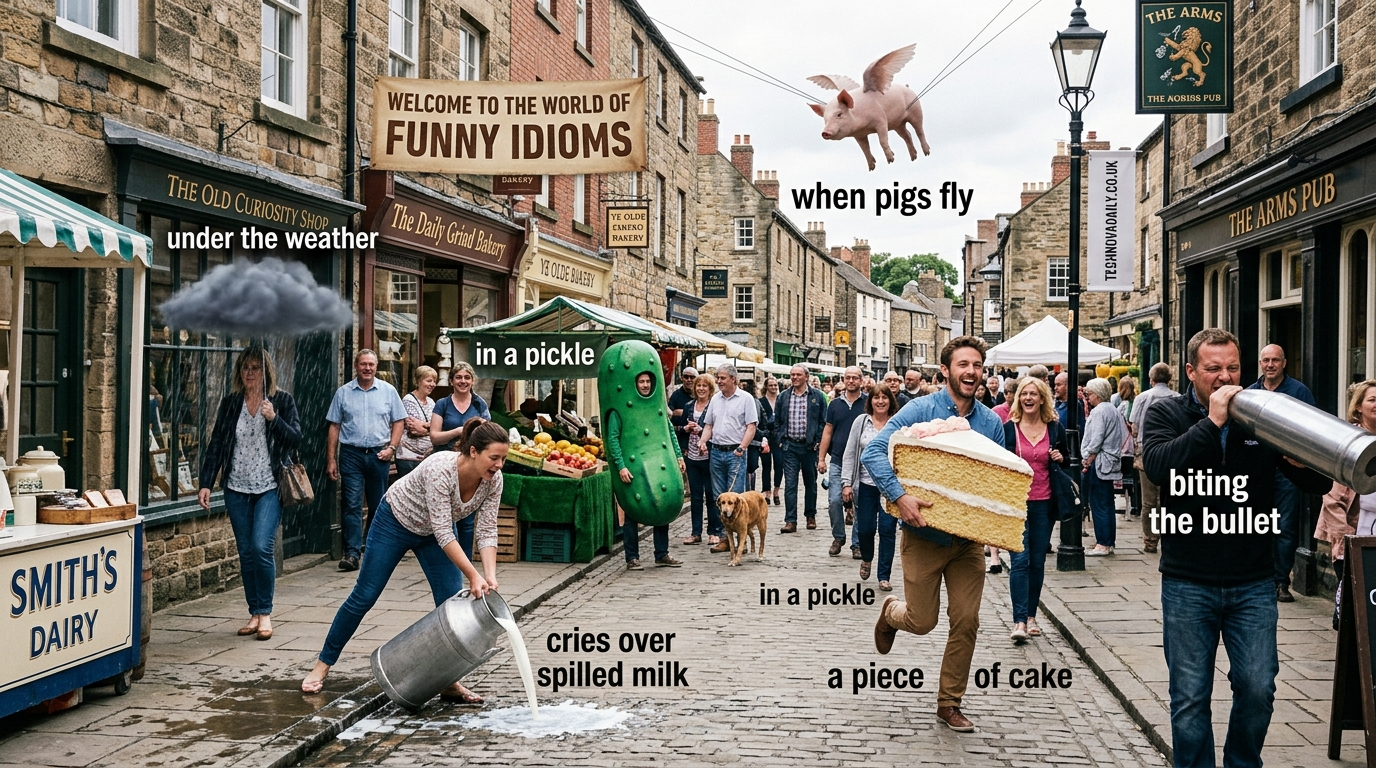
Funny idioms are expressions that make English conversations more interesting because their literal meanings can sound strange, silly, or unexpected. For example, “when pigs fly” refers to something that will probably never happen, while “spill the beans” means to reveal a secret.
English learners, students, and native speakers use idioms in everyday conversations, books, movies, and informal writing. Learning these expressions can help readers understand jokes, follow conversations, and use English more naturally.
In this article, you’ll find 50 funny idioms, their meanings, and simple examples. The expressions are grouped by topic to make them easier to understand and remember.
What Are Funny Idioms?
Funny idioms are expressions whose intended meanings differ from the literal meanings of their words. They often create amusing mental pictures, such as a pig flying through the sky or someone holding a horse still. These expressions are part of everyday English, even though their wording may seem strange to someone learning the language.
For example, when someone says, “I’m going to hit the hay,” they aren’t planning to strike a pile of grass. They simply mean they’re going to bed. Similarly, “a piece of cake” means something is easy to do, rather than an actual slice of dessert.
People use funny idioms to add humor, describe situations, and express ideas in fewer words. However, the meaning can depend on the context, so English learners should study each expression alongside an example sentence.
50 Funny Idioms With Meanings and Examples
Here are 50 funny idioms with simple definitions and everyday examples. Some are humorous because of their unusual wording, while others are popular expressions that can sound amusing when taken literally.
1. When Pigs Fly
Meaning: Something that is very unlikely or will probably never happen.
Example: My brother says he’ll clean his room every day. Sure, when pigs fly!
2. Let the Cat Out of the Bag
Meaning: To reveal a secret, either by accident or on purpose.
Example: Sara let the cat out of the bag when she told everyone about the surprise birthday party.
3. Spill the Beans
Meaning: To reveal secret information.
Example: We planned a surprise trip for Dad, but my little sister spilled the beans.
4. Hold Your Horses
Meaning: To wait, slow down, or be patient.
Example: Hold your horses! We haven’t even packed our bags yet.
5. Hit the Hay
Meaning: To go to bed or get some sleep.
Example: I’m exhausted after studying all day. I’m going to hit the hay early tonight.
6. Couch Potato
Meaning: A person who spends a lot of time sitting and watching television or relaxing.
Example: My uncle becomes a couch potato every weekend and watches football for hours.
7. A Piece of Cake
Meaning: Something that is very easy to do.
Example: The English test was a piece of cake because I had studied all the lessons.
8. Barking Up the Wrong Tree
Meaning: To blame, question, or approach the wrong person or pursue the wrong idea.
Example: If you think I ate your last cookie, you’re barking up the wrong tree. Ask my brother!
9. The Elephant in the Room
Meaning: An obvious problem or uncomfortable topic that people avoid discussing.
Example: Nobody wanted to talk about the broken television, but it was the elephant in the room.
10. A Wild Goose Chase
Meaning: A search or attempt that is unlikely to succeed or wastes time.
Example: Looking for my missing keys in the garden was a wild goose chase because they were in my pocket.
Funny Idioms About Animals
Animal idioms are common in English. They use cats, dogs, horses, pigs, and other creatures to describe human behavior, feelings, and everyday events. Some sound especially funny because they create pictures that would be unusual in real life.
11. Make a Pig’s Ear of Something
Meaning: To do something very badly or make a mess of it.
Example: I tried to fix the kitchen tap, but I made a pig’s ear of the whole job.
12. Let Sleeping Dogs Lie
Meaning: To avoid bringing up an old problem that could cause trouble again.
Example: They finally stopped arguing about the holiday, so let’s let sleeping dogs lie.
13. Butterflies in Your Stomach
Meaning: To feel nervous or excited about something.
Example: I had butterflies in my stomach before speaking in front of the whole class.
14. The Cat’s Pajamas
Meaning: Someone or something especially good, appealing, or impressive. This is a playful, somewhat old-fashioned expression.
Example: Everyone loved the new café. They said its chocolate cake was the cat’s pajamas.
15. Go on a Wild Goose Chase
Meaning: To waste time looking for something that is difficult or impossible to find.
Example: I went on a wild goose chase trying to find a shop that was already closed.
16. Monkey See, Monkey Do
Meaning: People copy what others do, often without thinking.
Example: The children started dancing after watching their teacher. Monkey see, monkey do!
17. Get Someone’s Goat
Meaning: To annoy or irritate someone.
Example: My little brother gets my goat by borrowing my headphones without asking.
18. Busy as a Bee
Meaning: Very busy and active.
Example: Mom was busy as a bee preparing dinner for our family party.
19. A Fish Out of Water
Meaning: A person who feels uncomfortable or out of place in an unfamiliar situation.
Example: I felt like a fish out of water at my first dance class because everyone else knew the steps.
20. Put the Cart Before the Horse
Meaning: To do things in the wrong order.
Example: Buying furniture before finding a house is putting the cart before the horse.
Funny Idioms About Food
Food-related idioms are often heard in everyday English. They describe feelings, people, work, and common situations rather than actual meals. Expressions such as “spill the beans” and “a piece of cake” are familiar examples.
21. The Big Cheese
Meaning: An important person, usually someone with authority.
Example: Our manager is the big cheese in the office, so everyone asks him about major decisions.
22. Bring Home the Bacon
Meaning: To earn money to support yourself or your family.
Example: Both my parents work hard to bring home the bacon.
23. Butter Someone Up
Meaning: To flatter someone to gain their favor.
Example: He tried to butter up his teacher by praising her lessons before asking for an extension.
24. Full of Beans
Meaning: Full of energy and enthusiasm.
Example: The children were full of beans after eating breakfast and were ready to play outside.
25. Cool as a Cucumber
Meaning: Very calm, especially in a stressful situation.
Example: Everyone was nervous before the competition, but Ali was as cool as a cucumber.
26. In a Pickle
Meaning: In a difficult or awkward situation.
Example: I was in a pickle when I lost my wallet just before paying for lunch.
27. When Life Gives You Lemons
Meaning: When life brings problems, try to make something good out of them. The full saying is “When life gives you lemons, make lemonade.”
Example: I didn’t get the job I wanted, so I started a small business. When life gives you lemons, make lemonade!
28. Cry Over Spilt Milk
Meaning: To be upset about something that has already happened and cannot be changed.
Example: We missed the bus, but there’s no point crying over spilt milk. Let’s catch the next one.
29. A Bad Apple
Meaning: A person who behaves badly or causes trouble in a group.
Example: The coach removed the bad apple from the team after repeated arguments with other players.
30. Sour Grapes
Meaning: Pretending to dislike something because you cannot have it or did not get it.
Example: When Jake lost the contest, he said the prize was boring. His friends knew it was just sour grapes.
Funny Idioms About People and Relationships
English speakers often use humorous idioms to describe personalities, friendships, habits, and social behavior. These expressions can make a conversation more playful, especially when friends and family are talking casually.
31. Smart Cookie
Meaning: A clever person who makes good decisions or solves problems.
Example: My sister is a smart cookie. She fixed the computer without asking anyone for help.
32. Wear Your Heart on Your Sleeve
Meaning: To show your feelings openly.
Example: Maria wears her heart on her sleeve, so everyone knows when she’s happy or upset.
33. A Tough Cookie
Meaning: A strong person who can handle difficult situations.
Example: Grandma is a tough cookie. She managed the family business through many hard times.
34. Chicken Out
Meaning: To decide not to do something because of fear.
Example: I wanted to ride the roller coaster, but I chickened out when I saw how high it was.
35. Older Than the Hills
Meaning: Very old or having existed for a long time.
Example: My grandfather says that this joke is older than the hills, but he still laughs at it.
36. Have a Laugh
Meaning: To enjoy something funny or share a moment of amusement.
Example: We watched an old comedy film and had a good laugh together.
37. Have a Bee in Your Bonnet
Meaning: To be very focused on an idea or subject, often to the point of talking about it repeatedly.
Example: My friend has a bee in her bonnet about learning French and mentions it in every conversation.
38. See the World Through Rose-Colored Glasses
Meaning: To see things in an overly positive way and overlook problems.
Example: My brother sees the world through rose-colored glasses and believes every plan will work perfectly.
39. Talk Someone’s Ear Off
Meaning: To talk to someone for a very long time, often without giving them much chance to speak.
Example: My neighbor talked my ear off about his new car for nearly an hour.
40. Have Bigger Fish to Fry
Meaning: To have more important things to do or worry about.
Example: I can’t argue about a tiny mistake right now. I have bigger fish to fry before the meeting.
Funny Idioms About Everyday Situations
Many idioms describe ordinary events, such as getting ready for work, dealing with problems, or making a decision. Their literal wording can sound odd, but their meanings are useful in daily English.
41. Call It a Day
Meaning: To stop working or doing an activity for the day.
Example: We’ve finished most of the project, so let’s call it a day and continue tomorrow.
42. Put Your Foot in Your Mouth
Meaning: To say something embarrassing or inappropriate by mistake.
Example: I put my foot in my mouth when I congratulated Sam on a promotion he hadn’t received.
43. Make a Mountain Out of a Molehill
Meaning: To turn a small problem into something that seems much bigger.
Example: It’s only a spelling mistake. Don’t make a mountain out of a molehill.
44. Rain on Someone’s Parade
Meaning: To spoil someone’s happiness or excitement.
Example: I don’t want to rain on your parade, but the picnic may be cancelled because of the storm.
45. Have a Light-Bulb Moment
Meaning: To suddenly understand something or think of a good idea.
Example: I had a light-bulb moment while solving the maths problem and finally found the answer.
46. Keep Your Eyes Peeled
Meaning: To watch carefully or stay alert for something.
Example: Keep your eyes peeled for the blue bus when you reach the station.
47. Kick the Bucket
Meaning: An informal and often humorous expression meaning to die. It can sound disrespectful when discussing a real person’s death.
Example: In the old comedy film, the character joked that his ancient car would kick the bucket any day.
48. Get the Ball Rolling
Meaning: To start an activity, project, or process.
Example: Let’s get the ball rolling by choosing a date for our school trip.
49. Drop Someone Like a Hot Potato
Meaning: To quickly stop dealing with someone or something that has become difficult or troublesome.
Example: The company dropped the unreliable supplier like a hot potato after several late deliveries.
50. Beat Around the Bush
Meaning: To avoid talking directly about a subject.
Example: Stop beating around the bush and tell me why you missed the class.
Funny Idioms for English Learners and Students
Learning funny idioms can help students understand informal English, especially when watching films, listening to music, reading stories, or talking with native speakers. Many expressions have meanings that cannot be understood by translating each word separately. For example, “break the ice” means to make people feel more comfortable when they first meet.
Students can learn idioms by grouping them according to topics such as animals, food, feelings, and daily activities. Reading example sentences and creating their own can also help them remember each expression. English teachers can use short dialogues, matching games, and quizzes to make idiom lessons more enjoyable.
How to Use Funny Idioms Correctly
Understanding an idiom’s meaning is only the first step. English learners should also know when and where to use it. Some expressions, such as “a piece of cake” and “hold your horses,” are common in casual conversations, while others may sound old-fashioned or unsuitable in certain situations.
Here are some useful ways to practise funny idioms:
- Learn the full expression: Remember the entire phrase instead of translating each word separately.
- Read example sentences: See how an idiom works in a real conversation.
- Practise speaking: Use one or two new expressions when talking with friends or classmates.
- Understand the tone: Some idioms are playful, while others can sound rude or insensitive.
- Avoid formal use when unsuitable: In academic papers, business reports, and official letters, direct language is often clearer.
- Review regularly: Write down new idioms and revisit them to help retain their meanings.
For example, “get someone’s goat” is suitable for a casual conversation about something annoying, but it may not fit a formal workplace report. Likewise, “kick the bucket” is an informal expression about death and should be avoided when speaking sensitively about someone’s loss.
Frequently Asked Questions About Funny Idioms
1. What are the funniest idioms in English?
Some amusing English idioms include “when pigs fly,” “hold your horses,” “spill the beans,” “couch potato,” and “a wild goose chase.” Their literal meanings create funny images, but each expression has a different figurative meaning.
2. What is a funny idiom with a strange meaning?
“When pigs fly” is a well-known example. It describes something that is extremely unlikely to happen. The funny image of pigs flying makes the expression easy to remember.
3. What are 10 common funny idioms?
Ten commonly known expressions are “when pigs fly,” “spill the beans,” “hold your horses,” “a piece of cake,” “couch potato,” “let the cat out of the bag,” “hit the hay,” “the elephant in the room,” “butterflies in your stomach,” and “beat around the bush.”
4. How do funny idioms help English learners?
Funny idioms can help learners understand everyday expressions, expand their vocabulary, and follow informal conversations. Studying them with examples also helps learners understand how context changes the meaning of a phrase.
5. Can I use funny idioms in formal writing?
Some idioms are acceptable in informal articles and conversational writing, but many are unsuitable for academic or official documents. In formal writing, use clear and direct wording unless the idiom fits the purpose and tone.
6. What is the difference between an idiom and a funny phrase?
An idiom is an established expression whose intended meaning differs from the literal meanings of its words. A funny phrase can simply be a humorous combination of words without having an established figurative meaning. For example, “spill the beans” is an idiom, while an original joke about a dancing sandwich is just a funny phrase.
7. Are funny idioms used in everyday conversations?
Yes. Many funny idioms are used in casual conversations, including “a piece of cake,” “hold your horses,” “get someone’s goat,” and “hit the hay.” Their use depends on the situation, the speaker, and the audience.
8. How can I memorize funny English idioms?
Learn a few idioms at a time, group them by topic, read example sentences, and practise using them in your own conversations. Revisiting the expressions regularly can help you remember their meanings and correct usage.
Conclusion
Funny idioms are an enjoyable part of the English language. Expressions such as “when pigs fly,” “spill the beans,” and “hold your horses” may sound strange when taken literally, but they have clear meanings in everyday conversations. Learning these phrases can help English students understand informal speech, follow films and stories, and express themselves more naturally.
