



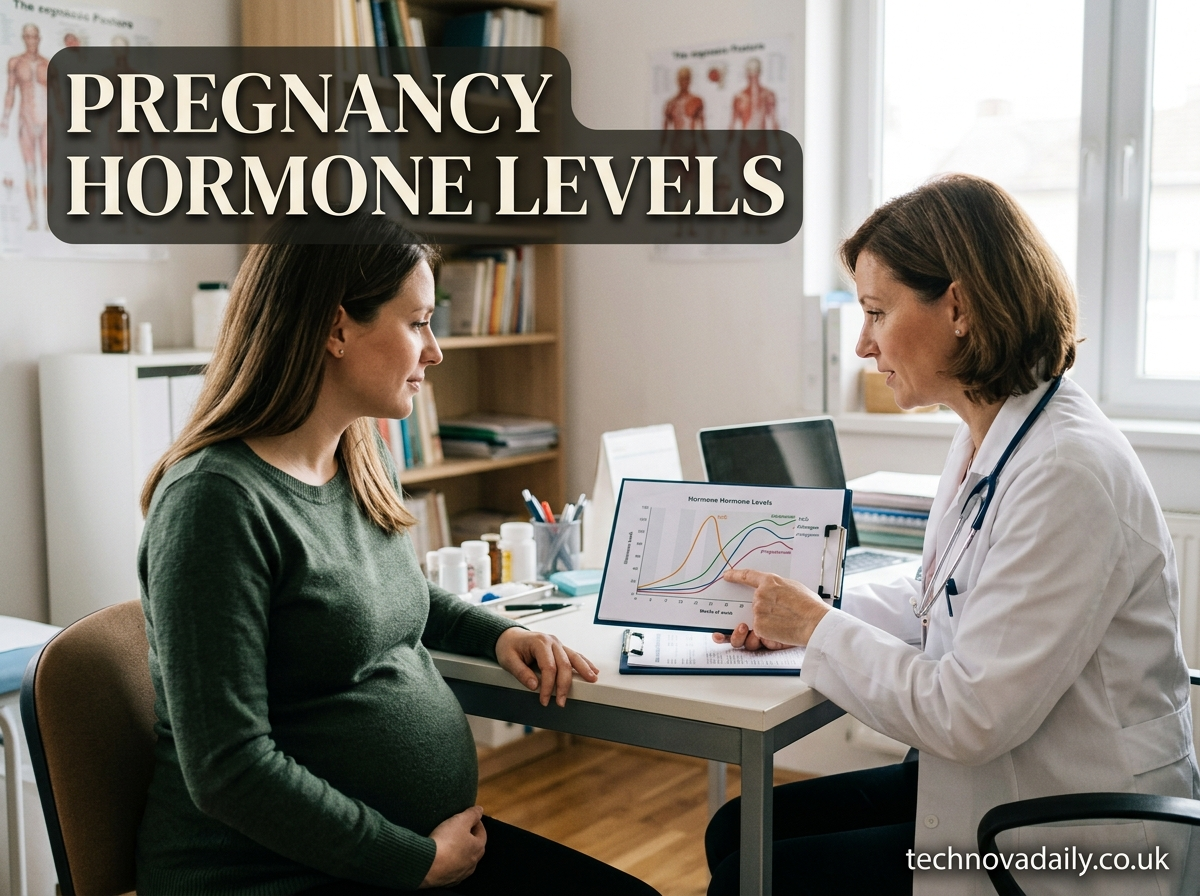
Pregnancy hormone levels change throughout pregnancy to support the mother’s body and the baby’s development. Human chorionic gonadotropin (hCG) is the hormone most commonly linked to pregnancy because home pregnancy tests and blood tests detect it. Other hormones, including progesterone and estrogen, also help maintain pregnancy and prepare the body for childbirth.
Normal pregnancy hormone levels depend on how many weeks pregnant you are, the hormone being measured, and the laboratory performing the test. A single blood test cannot always tell whether a pregnancy is developing normally. Doctors may look at changes in hormone levels over time and use ultrasound findings to understand what is happening.
What Are Pregnancy Hormone Levels?
Pregnancy hormone levels refer to the amount of certain hormones in the blood or body during pregnancy. These hormones send signals that help the uterus support the developing baby, maintain the uterine lining, and prepare the body for later stages of pregnancy. Their levels change as the pregnancy progresses.
The hormone most often measured to detect pregnancy is human chorionic gonadotropin, also called hCG. After a fertilized egg attaches to the uterine lining, the developing placenta begins producing hCG. This hormone supports early pregnancy and helps signal the body to maintain progesterone production. Doctors may measure hCG when confirming an early pregnancy or investigating symptoms such as bleeding or abdominal pain.
Pregnancy hormones do not follow the same pattern or rise at the same rate. hCG usually rises quickly during the first weeks, while progesterone and estrogen continue to support pregnancy as the placenta develops. Hormone levels can vary widely between healthy pregnancies, so results should be interpreted according to pregnancy dates, symptoms, and medical history.
Which Hormones Increase During Pregnancy?
Several hormones work together to support pregnancy. Their levels and effects change as the placenta develops and the baby’s needs grow.
Human Chorionic Gonadotropin (hCG)
hCG is the hormone detected by most pregnancy tests. Its levels rise after implantation and usually increase quickly during early pregnancy. A blood test can measure the exact amount of hCG, while a urine test usually shows whether enough of the hormone is present to produce a positive result.
Doctors may check hCG more than once if they need to assess an early pregnancy. The pattern of change can provide useful information, although hCG results alone cannot confirm the location or health of a pregnancy. Levels commonly reach their highest point around weeks 8 to 10 and then decline.
Progesterone
Progesterone helps prepare and maintain the uterine lining so that pregnancy can continue. During early pregnancy, the corpus luteum in the ovary produces much of this hormone. As the placenta develops, it takes over most progesterone production.
Progesterone also helps keep the uterus from contracting too early. Its levels generally rise as pregnancy progresses, but the expected range depends on the stage of pregnancy and the laboratory’s testing method. A low result may need further assessment, but one progesterone test cannot determine the outcome of every pregnancy.
Estrogen
Estrogen supports the growth of the uterus, increases blood flow, and helps the breasts prepare for feeding a baby. During pregnancy, the placenta becomes a major source of estrogen, working with other hormones to support the developing fetus.
Estrogen levels generally increase as pregnancy advances. They can also vary according to the stage of pregnancy and individual factors. Doctors do not usually measure estrogen routinely in every pregnancy because other examinations and tests are more useful for standard prenatal care.
Human Placental Lactogen (hPL)
Human placental lactogen, or hPL, is produced by the placenta. It helps change how the mother’s body uses nutrients so that more energy is available to support the growing baby. It also plays a role in preparing the breasts for lactation.
hPL levels generally increase as the placenta grows. Although this hormone is part of normal pregnancy, it is not commonly measured as a routine test to check whether a pregnancy is healthy.
Pregnancy Hormone Levels by Week: hCG Chart
The hCG chart below shows commonly cited approximate ranges during pregnancy. These values are measured in milli-international units per milliliter (mIU/mL) and are based on weeks counted from the first day of the last menstrual period.
| Pregnancy week | Approximate hCG range (mIU/mL) |
|---|---|
| 3 weeks | 5–50 |
| 4 weeks | 5–426 |
| 5 weeks | 18–7,340 |
| 6 weeks | 1,080–56,500 |
| 7–8 weeks | 7,650–229,000 |
| 9–12 weeks | 25,700–288,000 |
| 13–16 weeks | 13,300–254,000 |
| 17–24 weeks | 4,060–165,400 |
| 25–40 weeks | 3,640–117,000 |
Source: Cleveland Clinic’s hCG reference chart. Ranges are approximate and may differ between laboratories and medical references.
These numbers are guides, not strict limits for a healthy pregnancy. For example, two people at the same pregnancy week may have very different hCG results and still have healthy pregnancies. The exact timing of ovulation and implantation can also affect the result, particularly during the first few weeks.
Pregnancy weeks are usually counted from the first day of the last menstrual period, not from the date of conception. This means that the first two weeks of pregnancy dating generally occur before conception. If your hCG result falls outside a chart’s range, your doctor may consider your dates, symptoms, repeat blood tests, and ultrasound findings before drawing conclusions.
How Do hCG Levels Change in Early Pregnancy?
After implantation, hCG levels usually rise quickly during early pregnancy. The rate of increase often slows as the starting level becomes higher. Although hCG is sometimes described as doubling every 48 hours, this is not a rule that applies to every pregnancy. A healthy pregnancy may show a slower increase, depending on the starting level and other factors.
Doctors may order two quantitative hCG blood tests, often separated by about 48 hours, when they need more information about an early pregnancy. Comparing the results helps show whether the hormone is rising, staying similar, or falling. The timing between tests and the initial result matter when interpreting the change.
A rising hCG level can be reassuring, but it does not by itself prove that a pregnancy is inside the uterus or developing normally. Similarly, a slower rise does not automatically mean a miscarriage. When the results are unclear, a healthcare professional may recommend further blood tests and a transvaginal ultrasound. These assessments help distinguish between a pregnancy that is simply earlier than expected and one that needs medical attention.
What Do Low Pregnancy Hormone Levels Mean?
Low hCG levels may occur when a pregnancy is earlier than expected. If ovulation happened later than estimated, the pregnancy may be less advanced than the dates suggest. This is one reason a single hCG result cannot always provide a clear answer about pregnancy development.
Low or slowly rising hCG can also occur with an early pregnancy loss or an ectopic pregnancy, in which the pregnancy develops outside the uterus. A falling hCG level may indicate that a pregnancy is not continuing, but a healthcare professional must assess the full situation. Depending on the findings, repeat blood tests and ultrasound examinations may be needed.
Low progesterone levels can also raise questions about early pregnancy health. However, a progesterone result alone cannot reliably establish the cause of a problem or predict the outcome in every case. If your test results are lower than expected, discuss them with your doctor instead of trying to diagnose the pregnancy from an online chart.
What Do High Pregnancy Hormone Levels Mean?
High hCG levels can be normal, particularly when a pregnancy is further along than expected. Differences in ovulation dates, implantation timing, and individual hormone production can all affect the result. A level that appears high on a chart may still be within the range seen in a healthy pregnancy.
Sometimes, higher-than-expected hCG levels occur in twin or multiple pregnancies. They may also be associated with certain pregnancy complications, including a molar pregnancy. However, hCG levels overlap widely between pregnancies, so a blood test cannot confirm twins or identify a specific complication on its own.
If your hCG result is higher than expected, your doctor may review your pregnancy dates and recommend an ultrasound when appropriate. An ultrasound can help establish the location of the pregnancy and assess the number of embryos once they are visible. Your symptoms, test history, and clinical findings are all part of the assessment.
How Are Pregnancy Hormone Levels Tested?
Blood Pregnancy Test
A blood pregnancy test measures hCG in a sample collected from a vein. A qualitative blood test reports whether hCG is detected, while a quantitative beta-hCG test measures the amount of the hormone. Quantitative testing can be helpful when a doctor needs to follow changes in early pregnancy.
Blood tests can detect smaller amounts of hCG than many urine tests, so they may identify pregnancy earlier. However, the timing of testing still matters. If the test is done too soon, the result may not yet show a detectable level. A doctor may recommend repeating the test when pregnancy is suspected but the first result is unclear.
Urine Pregnancy Test
A home pregnancy test detects hCG in urine. Many tests are designed for use around the time of a missed period, although sensitivity varies between brands. Following the instructions carefully and testing at the recommended time can improve the chance of getting an accurate result.
Testing too early can lead to a false-negative result because hCG has not yet reached the test’s detection level. If your period does not arrive and the first test is negative, repeat the test after a few days or contact a healthcare professional. A positive home test generally means hCG has been detected, but it does not establish the location or development of the pregnancy.
What Do Progesterone Levels Mean During Pregnancy?
Progesterone supports the uterine lining and helps create conditions for pregnancy to continue. Its production changes as the corpus luteum and placenta contribute at different stages. Levels may differ from one person to another, so results need to be assessed against the appropriate pregnancy stage and laboratory reference range.
A doctor may request a progesterone test when investigating early pregnancy symptoms or assessing certain fertility concerns. A low result can be associated with a pregnancy that is not developing normally, but it does not always explain why a problem is occurring. Progesterone testing is therefore interpreted alongside symptoms, hCG measurements, and ultrasound findings when needed.
Do not start progesterone supplements or change a prescribed dose based only on an online chart. Whether treatment is appropriate depends on your medical history and the reason for testing. Your healthcare professional can explain your result and discuss the next steps.
When Do Pregnancy Hormone Levels Peak?
hCG usually reaches its highest level around weeks 8 to 10 of pregnancy. After this point, levels commonly decrease and then settle into a lower range for the remainder of pregnancy. This decline is a normal part of the usual hCG pattern and does not automatically mean that something is wrong.
Progesterone and estrogen follow different patterns. Both generally continue to rise as pregnancy progresses and the placenta supports the baby’s development. Their levels are affected by several biological factors, so there is no single chart that describes every pregnancy hormone in the same way.
Because hormones change throughout pregnancy, a result must be interpreted according to the week in which it was measured. A falling hCG level after its usual peak can be normal, while a fall during early pregnancy may need investigation. The timing of the test and the wider clinical picture help determine what the result means.
When Should You See a Doctor About Pregnancy Hormone Levels?
Contact a healthcare professional if you have a positive pregnancy test and need advice about prenatal care, or if your blood test results are unclear. Your doctor can help estimate how far along the pregnancy is, decide whether repeat hCG testing is needed, and determine when an ultrasound may be useful. Do not rely on hormone numbers alone to assess pregnancy health.
Seek urgent medical assessment if you experience vaginal bleeding with significant pain, persistent or severe abdominal pain, or symptoms that concern you. Sudden severe abdominal pain, shoulder-tip pain, fainting, or marked weakness may indicate an ectopic pregnancy or internal bleeding and require emergency care. Do not wait for another hormone test if these symptoms occur.
Even when hormone levels fall within a reference range, symptoms and clinical findings still matter. Likewise, a result outside the expected range does not always mean that the pregnancy will have a poor outcome. Your healthcare professional can interpret the results and arrange follow-up based on your circumstances.
Frequently Asked Questions About Pregnancy Hormone Levels
What Are Normal Pregnancy Hormone Levels?
There is no single normal number for all pregnancy hormones. hCG levels vary by pregnancy week, while progesterone and estrogen follow their own patterns. Your laboratory’s reference ranges and your doctor’s assessment are the best guides for understanding individual results.
What Should hCG Levels Be at 4 Weeks Pregnant?
A commonly cited hCG range at four weeks is approximately 5–426 mIU/mL. However, ranges vary by laboratory and reference source. A result outside this range does not provide a diagnosis by itself, so your doctor may consider your dates and repeat testing if needed.
Do hCG Levels Double Every 48 Hours?
No. hCG often rises quickly in early pregnancy, but it does not have to double exactly every 48 hours. The expected rate of increase depends partly on the starting level. Doctors interpret changes between tests rather than using a strict doubling rule for every pregnancy.
Can You Have Low hCG and Still Have a Healthy Pregnancy?
Yes. A low result may reflect an earlier pregnancy than expected, particularly if ovulation occurred later than estimated. Some healthy pregnancies also have lower hCG levels than the average. Repeat testing and ultrasound findings may help clarify the situation.
Do High hCG Levels Mean Twins?
Not necessarily. Twin pregnancies can have higher hCG levels, but the ranges overlap with those of single pregnancies. An ultrasound, performed at the appropriate time, is used to assess how many embryos are present.
When Do Pregnancy Hormone Levels Peak?
hCG generally peaks around weeks 8 to 10 and then declines. Estrogen and progesterone follow different patterns and generally continue to rise during pregnancy. The timing and amount of change vary between hormones and individuals.
Can a Pregnancy Test Be Negative When Hormone Levels Are Low?
Yes. If you test before enough hCG has built up in your urine, the result may be negative even if you are pregnant. If your period is late, repeat the test after a few days or speak with a healthcare professional.
What Hormone Confirms Pregnancy?
hCG is the hormone detected by standard urine and blood pregnancy tests. A positive result usually indicates pregnancy, but further assessment may be needed to confirm the location and development of the pregnancy.
Can Progesterone Levels Predict a Miscarriage?
A progesterone result can provide information in some early pregnancy assessments, but it cannot reliably predict the outcome in every case. Doctors consider other findings, including symptoms, hCG trends, and ultrasound results, before reaching a conclusion.
Do Pregnancy Hormone Levels Vary From Woman to Woman?
Yes. Hormone levels can vary widely even among people at the same stage of pregnancy. Differences in timing, biology, and laboratory methods all affect the results. That is why reference charts should be used as guides rather than as a way to diagnose pregnancy problems.
Conclusion
Pregnancy hormone levels provide useful information about the changes taking place in the body during pregnancy. hCG helps detect pregnancy and is often measured during early pregnancy assessments, while progesterone, estrogen, and hPL support the uterus, placenta, and baby’s development. Each hormone follows a different pattern, and the expected level depends on the stage of pregnancy.
An hCG chart can help you understand typical ranges, but no single number can confirm that a pregnancy is healthy or identify every possible complication. If your results are higher or lower than expected, discuss them with your healthcare professional. Repeat blood tests, ultrasound examinations, and your symptoms can help provide a clearer picture of your pregnancy.
