



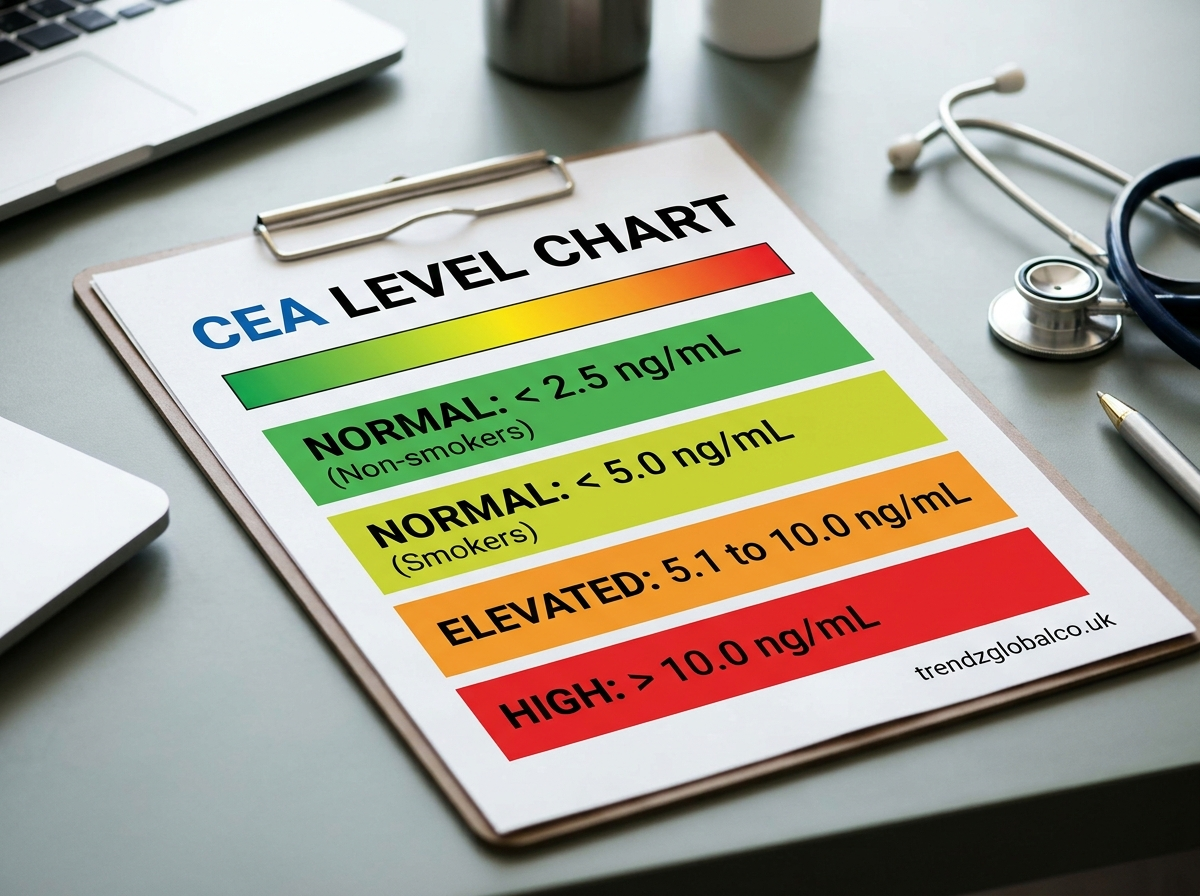
A CEA level chart helps you understand the results of a CEA blood test and whether your level falls within the expected range. CEA stands for carcinoembryonic antigen, a protein that can be found in the blood. Doctors often use this test to monitor certain cancers, especially colorectal cancer, and to check how well treatment is working.
For many laboratories, a CEA level below 3 ng/mL is considered within the reference range for non-smokers, while a level below 5 ng/mL may be used for smokers. However, these limits vary by laboratory. A result above the reference range does not automatically mean cancer, and a normal result does not rule it out.
What Is a CEA Blood Test?
A CEA blood test measures the amount of carcinoembryonic antigen in your blood. CEA is a protein associated with certain cells, and higher amounts may be found in some people with cancer. It can also rise because of non-cancerous conditions, such as liver disease, inflammation, or smoking.
Doctors most often use CEA testing to monitor people who have already been diagnosed with certain cancers. For example, the test may help track colorectal cancer during treatment or after surgery. If the CEA level falls during treatment, it may suggest that treatment is working. If it rises over time, the doctor may investigate further.
CEA testing is not generally recommended as a stand-alone screening test for cancer in people without symptoms. Other tests, scans, examinations, and medical history are needed to understand what a result means.
CEA Level Chart: Normal Range by Result
The following chart provides a general guide to common CEA levels. These are approximate ranges, not universal diagnostic cutoffs. Your laboratory’s reference range should take priority when interpreting your report.
| CEA level (ng/mL) | General interpretation |
|---|---|
| Below 3 | Often within the reference range for non-smokers |
| 3–5 | May be within range for some smokers; borderline or elevated for some non-smokers |
| 5–10 | Elevated in many laboratories; several causes are possible |
| 10–20 | More elevated and may require further assessment |
| Above 20 | Markedly elevated; needs clinical evaluation |
These categories are only a guide. A CEA result cannot identify the cause of an elevation on its own. The laboratory method, smoking status, medical history, and previous results all matter.
For example, a CEA level of 4 ng/mL may be above the reference range for a non-smoker but within the range used by some laboratories for smokers. A result of 12 ng/mL deserves medical review, but it does not confirm cancer by itself.
What Do Different CEA Levels Mean?
CEA Below 3 ng/mL
A CEA level below 3 ng/mL is commonly considered normal for non-smokers. If you are being monitored for cancer, a low result may be reassuring, especially when it has fallen from a previously higher level.
However, some cancers do not produce much CEA. A person can have cancer despite having a normal CEA result. Doctors therefore consider symptoms, examination findings, scans, and other test results before deciding what a low level means.
CEA Between 3 and 5 ng/mL
A CEA result between 3 and 5 ng/mL may be borderline or mildly elevated, depending on the laboratory and whether you smoke. Smoking can increase CEA levels even when cancer is not present.
Doctors may compare the result with earlier measurements and review other possible causes. If you are undergoing cancer monitoring, even a small change may be worth discussing with your healthcare team, particularly if the level continues to rise.
CEA Between 5 and 10 ng/mL
A CEA level between 5 and 10 ng/mL is above the reference range in many laboratories. Smoking, liver conditions, inflammation, and other non-cancerous problems may contribute to this result. Some cancers can also cause levels in this range.
The next step depends on your medical history and why the test was ordered. Your doctor may repeat the test, review other findings, or recommend additional investigations. One measurement cannot show whether cancer is present or how advanced it may be.
CEA Between 10 and 20 ng/mL
A CEA level between 10 and 20 ng/mL is more elevated than the usual reference range and should be reviewed by a healthcare professional. Possible causes include certain cancers and some non-cancerous conditions.
If you have a known cancer diagnosis, your doctor may compare this result with your previous levels and treatment history. A steady rise may lead to further assessment, such as imaging or other tests. The result should not be interpreted without considering the full clinical picture.
CEA Above 20 ng/mL
A CEA level above 20 ng/mL is markedly elevated in many laboratories. It can occur with certain cancers, including colorectal cancer, but the number alone cannot confirm a diagnosis or determine the stage of a cancer.
If your result is this high, contact your healthcare provider to discuss the findings and appropriate follow-up. Your doctor may consider repeat testing, imaging, and other investigations based on your symptoms and history. If you already have a cancer diagnosis, changes from your previous CEA levels may be particularly relevant.
What Is a Normal CEA Level for Smokers and Non-Smokers?
CEA reference ranges may differ depending on smoking status and the laboratory method used. Mayo Clinic Laboratories, for example, lists a reference value of 3.0 ng/mL or lower for non-smokers, while some smokers may have levels below 5.0 ng/mL. Other laboratories may use different limits.
Overview: Carcinoembryonic Antigen (CEA), Serum
+1
Smoking can raise CEA levels because it affects the body even when cancer is not present. Therefore, doctors need to know whether you smoke when reviewing your results. A mildly elevated result in a smoker may have a different explanation from the same result in a non-smoker.
Do not compare your result with a chart from another laboratory without checking the reference range on your report. If you are having repeated CEA tests to monitor cancer, using the same laboratory and testing method when possible can make changes easier to interpret.
What Causes High CEA Levels?
High CEA levels can occur because of cancer or non-cancerous health conditions. The test measures a marker rather than identifying the exact cause of a problem, so doctors consider other information before reaching a conclusion.
MedlinePlus
+1
Cancer-related causes include colorectal cancer and certain cancers of the lung, breast, pancreas, stomach, liver, and other organs. However, not every cancer produces CEA, and the amount produced varies from person to person.
Non-cancerous causes include smoking, liver disease, gallbladder problems, pancreatitis, inflammatory bowel disease, and some inflammatory conditions. These conditions can cause CEA to rise without cancer being present.
If your CEA result is above the reference range, your doctor may review your medical history, repeat the test, or order other investigations. The appropriate next step depends on the result, your symptoms, and whether you have a previous cancer diagnosis.
Does a High CEA Level Mean Cancer?
No. A high CEA level does not automatically mean you have cancer. Although certain cancers can raise CEA, smoking and several non-cancerous conditions can also affect the result. CEA testing alone cannot establish a cancer diagnosis.
MedlinePlus
+1
A normal CEA level does not guarantee that cancer is absent either. Some cancers produce little or no CEA, so the marker may remain within the reference range even when disease is present.
Doctors interpret CEA alongside symptoms, physical examinations, imaging studies, and other tests. If cancer is suspected, additional investigations may be needed to determine the cause. Avoid drawing conclusions from a single number without discussing it with your healthcare provider.
How Is the CEA Test Used to Monitor Cancer?
CEA testing is often used to follow certain cancers after diagnosis, particularly colorectal cancer. Doctors may measure CEA before treatment to establish a baseline and then check how the level changes during or after treatment.
Overview: Carcinoembryonic Antigen (CEA), Serum
+1
A falling CEA level may suggest that treatment is working, while a rising level may indicate that cancer is growing, returning, or not responding as expected. However, these patterns are not proof on their own. Other medical conditions can also affect CEA levels.
Doctors look at results over time rather than relying on one measurement. If CEA rises repeatedly after treatment, the healthcare team may recommend imaging or other tests to investigate the change. CEA monitoring is one part of follow-up care, not a replacement for recommended scans or examinations.
What Should You Do If Your CEA Level Is High?
If your CEA result is elevated, arrange a discussion with your healthcare provider. Start by checking the reported value, the units, and the laboratory’s reference range. Mention whether you smoke, have any current health conditions, or are being monitored for cancer.
Your doctor may compare your current result with earlier tests to see whether the level is stable, falling, or rising. Depending on your history and findings, further testing may include a repeat CEA measurement, imaging, or other laboratory investigations.
Do not start treatment or assume you have cancer based on a CEA result alone. If you already have cancer, follow the monitoring schedule recommended by your oncology team. Seek prompt medical advice if you have new or worsening symptoms, regardless of whether your CEA level is normal.
Frequently Asked Questions About the CEA Level Chart
What is the normal CEA level?
A common reference value for non-smokers is 3.0 ng/mL or lower. Some laboratories use a higher upper limit, and smokers may have levels below 5.0 ng/mL that are considered acceptable. Always check the reference range provided with your result.
Overview: Carcinoembryonic Antigen (CEA), Serum
+1
Is a CEA level of 5 considered high?
A CEA level of 5 ng/mL may be considered elevated for a non-smoker, depending on the laboratory. Some laboratories allow values up to 5 ng/mL for smokers. Your doctor will consider your smoking status, medical history, and previous results.
Is a CEA level of 10 dangerous?
A CEA level of 10 ng/mL is elevated in many laboratories, but it does not automatically indicate cancer or an immediate emergency. It should be interpreted by a healthcare professional, who may recommend further testing based on your circumstances.
What does a CEA level above 20 mean?
A CEA level above 20 ng/mL is markedly elevated and warrants medical evaluation. It can occur with certain cancers, but the result alone cannot confirm cancer or determine its stage. Your doctor will consider other findings and may recommend imaging or additional tests.
Overview: Carcinoembryonic Antigen (CEA), Serum
+1
Can smoking cause elevated CEA levels?
Yes. Smoking can increase CEA levels even when cancer is not present. Tell your healthcare provider if you smoke so that your results can be interpreted appropriately.
Can CEA levels be normal in someone with cancer?
Yes. Some cancers do not produce enough CEA to raise the blood level. A normal result cannot rule out cancer, which is why doctors use other tests and clinical findings when needed.
MedlinePlus
+1
How often should CEA levels be checked during cancer treatment?
The schedule depends on the cancer type, treatment plan, and reason for monitoring. Your oncology team will decide when testing is appropriate and how the results should be compared over time.
Can a high CEA level return to normal?
Yes. CEA levels may fall when a non-cancerous cause improves or when cancer treatment is effective. However, the meaning of a falling level depends on the underlying cause and other clinical findings.
Conclusion
A CEA level chart can help you understand whether your blood test result falls within a typical reference range or is elevated. Non-smokers often have CEA levels at or below 3.0 ng/mL, while some smokers may have levels below 5.0 ng/mL. Exact limits vary by laboratory.
