



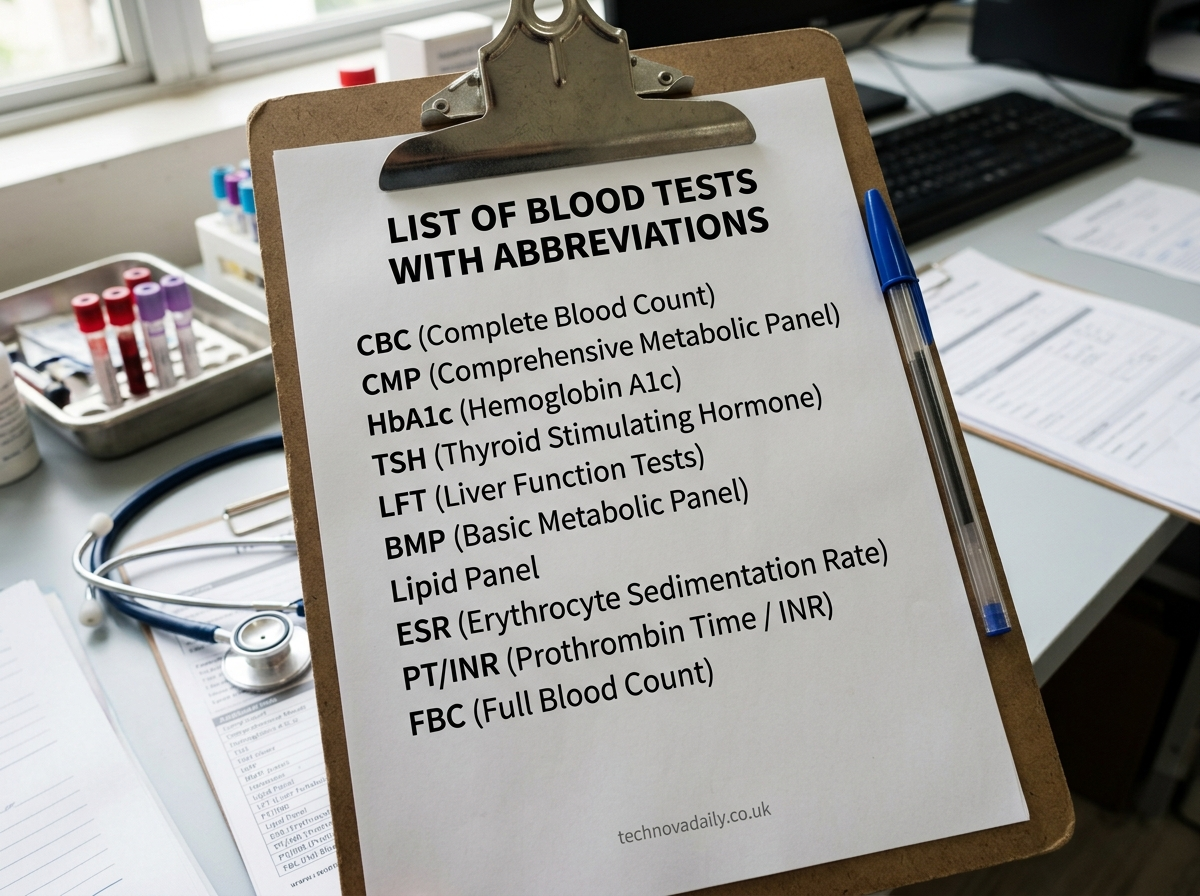
Blood tests help doctors check general health, investigate symptoms, and monitor different medical conditions. A laboratory report often uses short forms such as CBC, RBC, WBC, ALT, TSH, and HbA1c instead of writing the full name of every test. These abbreviations can be confusing if you do not know what they mean.
This guide provides a list of blood tests with abbreviations, their full forms, and their main uses. It covers common tests for blood cells, liver and kidney function, cholesterol, thyroid health, diabetes, hormones, inflammation, blood clotting, and heart health. Knowing these terms can help you understand your lab report, although a healthcare professional should interpret your results in the context of your health.
What Are Blood Test Abbreviations?
Blood test abbreviations are shortened forms of test names or measurements used by laboratories and healthcare professionals. They make reports easier to read and help identify specific tests without repeating long medical terms.
For example, CBC stands for complete blood count, which measures different types of blood cells. ALT stands for alanine aminotransferase, an enzyme commonly measured when assessing liver health. TSH means thyroid-stimulating hormone, which helps doctors evaluate thyroid function.
Some abbreviations describe an entire group of tests, while others refer to a single measurement. The meaning can also depend on the laboratory and the medical context, so always check the full test name when it appears on your report.
List of Common Blood Tests With Abbreviations
The following sections group common blood tests by what they measure. This makes it easier to find a particular abbreviation and understand why a doctor might order the test.
Complete Blood Count (CBC) Abbreviations
A complete blood count, or CBC, is a common blood test that measures different blood cells. It can help investigate anemia, infections, bleeding problems, and other health concerns.
- CBC — Complete Blood Count: Measures several types of blood cells and related values.
- RBC — Red Blood Cell Count: Measures the number of red blood cells.
- WBC — White Blood Cell Count: Measures the number of white blood cells involved in immune defense.
- Hgb or Hb — Hemoglobin: Measures the protein in red blood cells that carries oxygen.
- HCT — Hematocrit: Measures the proportion of blood made up of red blood cells.
- MCV — Mean Corpuscular Volume: Shows the average size of red blood cells.
- MCH — Mean Corpuscular Hemoglobin: Measures the average amount of hemoglobin in each red blood cell.
- MCHC — Mean Corpuscular Hemoglobin Concentration: Measures the average concentration of hemoglobin within red blood cells.
- RDW — Red Cell Distribution Width: Shows variation in red blood cell size.
- PLT — Platelet Count: Measures platelets, which help blood clot.
- MPV — Mean Platelet Volume: Measures the average size of platelets.
Doctors may use CBC results to investigate tiredness, weakness, fever, unexplained bruising, or other symptoms. No single CBC measurement can explain every condition, and the results are usually reviewed together.
Blood Chemistry Test Abbreviations
Blood chemistry tests measure substances in the blood that provide information about metabolism, fluid balance, and organ function. Two common panels are the basic metabolic panel and the comprehensive metabolic panel.
- BMP — Basic Metabolic Panel: Measures selected substances related to glucose, electrolytes, and kidney function.
- CMP — Comprehensive Metabolic Panel: Includes the main BMP measurements along with additional tests, including liver-related markers and proteins.
- Na — Sodium: Helps assess fluid balance and nerve and muscle function.
- K — Potassium: Helps assess electrolyte balance and normal heart and muscle activity.
- Cl — Chloride: Helps assess fluid and acid-base balance.
- CO₂ — Total Carbon Dioxide: Mainly reflects bicarbonate in a routine chemistry panel and helps assess acid-base balance.
- BUN — Blood Urea Nitrogen: Measures nitrogen from urea, a waste product processed by the kidneys.
- Cr — Creatinine: Measures a waste product used to help assess kidney function.
- eGFR — Estimated Glomerular Filtration Rate: Estimates how well the kidneys filter waste from the blood.
- Ca — Calcium: Measures calcium in the blood.
- Glu — Glucose: Measures the amount of sugar in the blood.
Doctors may order these tests during routine checkups or when evaluating dehydration, kidney problems, electrolyte changes, or other medical concerns. The exact tests included in each panel can vary by laboratory.
Liver Function Test Abbreviations
Liver blood tests measure enzymes, proteins, and substances processed by the liver. They can help identify patterns that may require further investigation.
- ALT — Alanine Aminotransferase: An enzyme found mainly in liver cells. Increased levels can indicate liver cell injury.
- AST — Aspartate Aminotransferase: An enzyme found in the liver, muscles, and other tissues.
- ALP — Alkaline Phosphatase: An enzyme associated with the liver, bile ducts, and bones.
- GGT — Gamma-Glutamyl Transferase: An enzyme that can help investigate liver and bile duct problems.
- TBIL — Total Bilirubin: Measures the total amount of bilirubin in the blood.
- DBIL — Direct Bilirubin: Measures the direct-reacting portion of bilirubin.
- TP — Total Protein: Measures the total amount of major proteins in the blood.
- ALB — Albumin: Measures a protein made by the liver.
- LDH — Lactate Dehydrogenase: An enzyme found in many tissues that may increase with cell or tissue injury.
Doctors interpret these results together with symptoms, medical history, and sometimes imaging or other tests. An elevated ALT or AST level does not automatically mean a person has a specific liver disease.
Cholesterol and Lipid Test Abbreviations
A lipid profile measures different types of fats in the blood. These results help doctors assess cholesterol levels and cardiovascular risk.
- TC — Total Cholesterol: Measures the total cholesterol in the blood.
- HDL — High-Density Lipoprotein: Often called good cholesterol because HDL particles help carry cholesterol away from tissues.
- LDL — Low-Density Lipoprotein: Often called bad cholesterol because higher levels can contribute to plaque buildup in arteries.
- TG — Triglycerides: Measures a type of fat used by the body for energy storage.
- VLDL — Very-Low-Density Lipoprotein: Refers to particles that carry triglycerides and other fats through the bloodstream.
Doctors consider the complete lipid profile along with factors such as age, blood pressure, smoking, diabetes, and family history. The appropriate cholesterol targets depend on a person’s overall cardiovascular risk.
Thyroid Test Abbreviations
Thyroid blood tests help evaluate the thyroid gland, which produces hormones that regulate metabolism, body temperature, and several other functions.
- TSH — Thyroid-Stimulating Hormone: Measures a hormone produced by the pituitary gland that signals the thyroid to produce hormones.
- FT4 — Free Thyroxine: Measures the unbound form of thyroxine available in the blood.
- FT3 — Free Triiodothyronine: Measures the unbound form of triiodothyronine.
- T4 — Thyroxine: Refers to the main hormone produced by the thyroid; a test may measure total T4 or free T4.
- T3 — Triiodothyronine: Refers to another thyroid hormone that affects metabolism.
TSH is often the first test used to assess thyroid function. Depending on the result and the person’s symptoms, a doctor may order free T4, T3, or other tests. A single result should not be used to diagnose a thyroid condition without considering the full clinical picture.
Diabetes and Blood Sugar Test Abbreviations
Blood glucose tests help detect diabetes, identify abnormal blood sugar levels, and monitor glucose control.
- FPG — Fasting Plasma Glucose: Measures blood glucose after a required fasting period.
- FBS — Fasting Blood Sugar: A common term for a fasting glucose test.
- RBS — Random Blood Sugar: Measures blood glucose at any time, regardless of when the person last ate.
- PPBS — Postprandial Blood Sugar: Measures blood glucose after a meal, at the specified time.
- HbA1c — Hemoglobin A1c: Reflects average blood glucose over approximately the previous two to three months.
- OGTT — Oral Glucose Tolerance Test: Measures how the body handles glucose after a measured glucose drink.
Doctors may use fasting glucose, HbA1c, or an OGTT to diagnose diabetes or prediabetes, depending on the situation. Diagnostic thresholds and testing requirements differ by test, and an abnormal result may need confirmation.
Iron, Vitamin, and Nutrient Test Abbreviations
Iron and vitamin tests help investigate certain types of anemia, nutritional deficiencies, and related symptoms. The choice of test depends on the person’s medical history and the suspected deficiency.
- Fe — Iron: Measures iron in the blood at the time of testing.
- Ferritin — Ferritin: Measures a protein that stores iron and is often used to assess iron stores.
- TIBC — Total Iron-Binding Capacity: Estimates the blood’s capacity to bind iron.
- TSAT — Transferrin Saturation: Shows the percentage of iron-binding sites occupied by iron.
- B12 — Vitamin B12: Measures the level of vitamin B12, which supports nerve function and red blood cell production.
- 25-OH Vitamin D — 25-Hydroxyvitamin D: The main blood test used to assess vitamin D status.
Doctors may order these tests when investigating fatigue, certain types of anemia, numbness, dietary concerns, or bone health. Ferritin can also rise during inflammation, so it may not always reflect iron stores on its own.
Hormone and Reproductive Blood Test Abbreviations
Hormone blood tests measure substances that help regulate reproduction, growth, metabolism, and other body functions.
- FSH — Follicle-Stimulating Hormone: Helps regulate egg development and sperm production.
- LH — Luteinizing Hormone: Helps regulate ovulation and reproductive hormone production.
- E2 — Estradiol: A form of estrogen often measured in reproductive health assessments.
- PRL — Prolactin: A hormone involved in breast milk production and other body functions.
- hCG — Human Chorionic Gonadotropin: A hormone commonly measured to detect and monitor pregnancy.
- Testosterone — Testosterone: A hormone involved in reproductive function, muscle development, and other processes.
Hormone levels can change with age, time of day, menstrual cycle stage, pregnancy, medications, and other factors. A doctor interprets these results according to the reason for testing.
Inflammation and Infection-Related Test Abbreviations
Some blood tests help detect inflammation or investigate a possible infection. These tests often provide clues rather than identifying the exact cause.
- ESR — Erythrocyte Sedimentation Rate: Measures how quickly red blood cells settle in a test tube over a set period.
- CRP — C-Reactive Protein: Measures a protein that can rise in response to inflammation.
- hs-CRP — High-Sensitivity C-Reactive Protein: Measures small increases in CRP and may be used in certain cardiovascular risk assessments.
- WBC — White Blood Cell Count: Measures white blood cells and may help assess infection or inflammation.
- Blood culture: A laboratory test used to look for bacteria or fungi in the bloodstream; it is not simply a routine blood count.
High ESR or CRP levels can occur in many conditions, including infections and inflammatory diseases. These markers do not identify the cause by themselves, so doctors may combine them with symptoms, examination findings, and other investigations.
Blood Clotting Test Abbreviations
Clotting tests assess parts of the body’s process for stopping bleeding. They may be ordered before selected procedures or when investigating bleeding, clotting, or certain medication effects.
- PT — Prothrombin Time: Measures how long blood takes to clot through a particular clotting pathway.
- INR — International Normalized Ratio: Standardizes PT results and is commonly used to monitor warfarin treatment.
- aPTT — Activated Partial Thromboplastin Time: Measures clotting time through another part of the clotting system.
- D-dimer — D-dimer: Measures a substance released when the body breaks down a blood clot.
These tests have different purposes. For example, a D-dimer result may help a clinician assess the likelihood of certain blood clots when used with the person’s symptoms and clinical risk. A positive result does not prove that a clot is present.
Kidney Function Test Abbreviations
Kidney tests help doctors assess how effectively the kidneys remove waste and maintain fluid and electrolyte balance.
- BUN — Blood Urea Nitrogen: Measures nitrogen from urea in the blood.
- Cr — Creatinine: Measures a waste product commonly used to assess kidney filtration.
- eGFR — Estimated Glomerular Filtration Rate: Estimates how efficiently the kidneys filter blood.
- UACR — Urine Albumin-to-Creatinine Ratio: Measures albumin in urine relative to creatinine. Despite its frequent use in kidney assessment, it is a urine test rather than a blood test.
- Na — Sodium: Helps assess fluid and electrolyte balance.
- K — Potassium: Helps assess electrolyte balance and muscle and heart function.
Creatinine and eGFR are often reviewed together. Doctors may also check urine albumin, blood pressure, previous results, and other information to assess kidney health. One abnormal result does not always mean chronic kidney disease is present.
Cardiac Blood Test Abbreviations
Cardiac blood tests help investigate certain heart-related symptoms and conditions. The tests ordered depend on whether a doctor is assessing possible heart muscle injury, heart failure, or another problem.
- TnI — Cardiac Troponin I: A protein measured when investigating heart muscle injury.
- TnT — Cardiac Troponin T: Another cardiac protein used to assess heart muscle injury.
- BNP — B-type Natriuretic Peptide: A substance that may rise when the heart is under increased strain.
- NT-proBNP — N-terminal pro-B-type Natriuretic Peptide: A marker used to help assess suspected heart failure.
- CK-MB — Creatine Kinase-MB: An enzyme marker that has been used to assess heart muscle injury, although cardiac troponin is generally preferred for this purpose.
Doctors interpret cardiac markers alongside symptoms, examination findings, ECG results, and sometimes repeat blood tests. Chest pain, sudden shortness of breath, or other possible heart attack symptoms require urgent medical attention rather than waiting for a routine blood test.
Cancer Marker Blood Test Abbreviations
Tumor markers are substances that may be measured in blood when investigating or monitoring certain cancers. Some can also rise in noncancerous conditions, and many cancers do not produce a specific marker.
- PSA — Prostate-Specific Antigen: Used in assessing prostate health and, in selected situations, prostate cancer risk or treatment response.
- CA-125 — Cancer Antigen 125: May be used in evaluating certain ovarian conditions and monitoring some ovarian cancers.
- CEA — Carcinoembryonic Antigen: May be used to monitor selected cancers, particularly colorectal cancer.
- AFP — Alpha-Fetoprotein: Used in selected situations involving liver cancer, germ cell tumors, and certain pregnancy assessments.
- CA 19-9 — Cancer Antigen 19-9: May help monitor certain pancreatic and other gastrointestinal cancers.
Tumor markers are not generally suitable as stand-alone cancer screening or diagnostic tests. Doctors decide whether they are appropriate based on symptoms, examination findings, imaging, medical history, and other test results.
Blood Test Abbreviations and Their Full Forms at a Glance
The following table provides a quick reference to commonly used blood test abbreviations.
| Abbreviation | Full form | Main purpose |
|---|---|---|
| CBC | Complete Blood Count | Measures blood cells |
| RBC | Red Blood Cell Count | Assesses red blood cell numbers |
| WBC | White Blood Cell Count | Assesses white blood cell numbers |
| Hgb / Hb | Hemoglobin | Measures oxygen-carrying protein |
| HCT | Hematocrit | Measures the proportion of blood made up of red cells |
| MCV | Mean Corpuscular Volume | Measures average red blood cell size |
| PLT | Platelet Count | Measures platelets |
| BMP | Basic Metabolic Panel | Checks selected chemistry markers |
| CMP | Comprehensive Metabolic Panel | Checks chemistry, kidney-related, and liver-related markers |
| Na | Sodium | Assesses an electrolyte |
| K | Potassium | Assesses an electrolyte |
| BUN | Blood Urea Nitrogen | Helps assess kidney function |
| Cr | Creatinine | Helps assess kidney filtration |
| eGFR | Estimated Glomerular Filtration Rate | Estimates kidney filtration |
| ALT | Alanine Aminotransferase | Assesses a liver-related enzyme |
| AST | Aspartate Aminotransferase | Assesses an enzyme found in several tissues |
| ALP | Alkaline Phosphatase | Assesses an enzyme associated with liver, bile ducts, and bones |
| GGT | Gamma-Glutamyl Transferase | Helps investigate liver and bile duct conditions |
| TC | Total Cholesterol | Measures total cholesterol |
| LDL | Low-Density Lipoprotein | Assesses cholesterol-related cardiovascular risk |
| HDL | High-Density Lipoprotein | Measures HDL cholesterol |
| TG | Triglycerides | Measures a type of blood fat |
| TSH | Thyroid-Stimulating Hormone | Assesses thyroid regulation |
| FT4 | Free Thyroxine | Measures free T4 hormone |
| FPG | Fasting Plasma Glucose | Measures fasting blood glucose |
| HbA1c | Hemoglobin A1c | Reflects average blood glucose over about 2–3 months |
| Fe | Iron | Measures iron in blood |
| TIBC | Total Iron-Binding Capacity | Assesses iron-binding capacity |
| B12 | Vitamin B12 | Assesses vitamin B12 status |
| FSH | Follicle-Stimulating Hormone | Assesses reproductive hormone function |
| LH | Luteinizing Hormone | Assesses reproductive hormone function |
| hCG | Human Chorionic Gonadotropin | Commonly used in pregnancy testing |
| ESR | Erythrocyte Sedimentation Rate | Assesses a nonspecific marker of inflammation |
| CRP | C-Reactive Protein | Measures a marker of inflammation |
| PT | Prothrombin Time | Assesses part of the clotting process |
| INR | International Normalized Ratio | Standardizes PT results |
| aPTT | Activated Partial Thromboplastin Time | Assesses another part of the clotting process |
| TnI / TnT | Cardiac Troponin I / T | Helps assess heart muscle injury |
| BNP | B-type Natriuretic Peptide | Helps assess heart strain and possible heart failure |
| PSA | Prostate-Specific Antigen | Assesses prostate-related conditions |
The exact abbreviations used on your report may differ between laboratories. Some entries in this table, such as tumor markers and cardiac markers, are ordered for particular clinical reasons rather than as part of a routine health check.
How to Read Blood Test Abbreviations on a Lab Report
A blood test report usually lists the test name, your result, the measurement unit, and a reference interval. Some laboratories also flag results that fall above or below their stated range.
An H usually means the result is high, while an L usually means it is low. These flags do not automatically mean that a serious health problem is present. A result may fall outside the reference interval because of medication, hydration, recent illness, biological variation, or other factors.
Reference intervals can differ between laboratories because of the methods used and the populations assessed. Age, sex, pregnancy, and other individual factors may also affect interpretation. If a result is marked abnormal, discuss it with your healthcare professional, who can consider your symptoms, medical history, and other findings.
Which Blood Tests Are Commonly Included in a Routine Checkup?
There is no single blood test panel that every person needs during a routine checkup. The tests selected depend on age, symptoms, personal and family medical history, risk factors, and preventive care recommendations.
A doctor may order a CBC to assess blood cells, a metabolic panel to check selected chemistry markers, a lipid profile to assess cholesterol, or a glucose test to evaluate blood sugar. Thyroid, iron, vitamin, kidney, and liver tests may be added when there is a clinical reason.
Not every person needs all these tests at once. Testing without a clear reason can lead to confusing or unexpected findings that require further assessment. Your healthcare professional can help determine which tests are appropriate for you.
Do All Blood Tests Require Fasting?
No. Many blood tests do not require fasting, but some tests may need preparation. Fasting glucose testing usually requires a period without food, while an HbA1c test generally does not require fasting. A lipid profile may be ordered with or without fasting, depending on the clinical purpose and the clinician’s instructions.
If fasting is required, the laboratory or healthcare professional should tell you how long to fast and whether you may drink water. Do not stop prescribed medicines unless your clinician specifically tells you to do so. If you accidentally eat or drink something that may affect the test, tell the laboratory staff before the sample is collected.
When Should You Ask a Doctor About Your Blood Test Results?
Ask your healthcare professional to explain results that are outside the reference range, have changed from previous tests, or do not fit with how you feel. It is often more useful to review the pattern across several results than to focus on one number.
Seek urgent medical care if you have severe symptoms such as chest pain, serious breathing difficulty, fainting, or confusion, regardless of whether you have a blood test report. If a laboratory or clinician contacts you about a critical result, follow their instructions promptly.
A blood test is one part of a medical assessment. Your symptoms, examination, medical history, medicines, and sometimes additional testing help determine what the results mean.
Frequently Asked Questions About Blood Test Abbreviations
What are the most common blood test abbreviations?
Common abbreviations include CBC for complete blood count, RBC for red blood cell count, WBC for white blood cell count, Hgb for hemoglobin, CMP for comprehensive metabolic panel, ALT for alanine aminotransferase, TSH for thyroid-stimulating hormone, LDL for low-density lipoprotein, and HbA1c for hemoglobin A1c. Each refers to a particular test or measurement.
What does CBC mean on a blood test?
CBC stands for complete blood count. It measures red blood cells, white blood cells, platelets, and related values such as hemoglobin and hematocrit. Doctors use the results to help investigate conditions such as anemia, infections, and some blood disorders.
What do H and L mean on blood test results?
H usually indicates a result above the laboratory’s reference interval, while L usually indicates a result below it. These flags identify results that may need review, but they do not diagnose a condition by themselves.
What does CMP stand for in blood work?
CMP stands for comprehensive metabolic panel. It is a group of blood tests that measures glucose, electrolytes, kidney-related markers, proteins, and several liver-related markers. Doctors may use it to assess general health or investigate particular symptoms.
What blood test abbreviations are related to the liver?
Common liver-related abbreviations include ALT, AST, ALP, GGT, TBIL, DBIL, and ALB. These tests measure enzymes, bilirubin, or proteins that help doctors assess liver health and investigate possible liver or bile duct problems.
What abbreviations are used for kidney function tests?
Common kidney-related abbreviations include BUN, Cr, and eGFR. Doctors may also check electrolytes and urine albumin-to-creatinine ratio (UACR). UACR is measured using urine, not blood, but it can provide useful information about kidney health.
What blood tests check for diabetes?
Common tests include FPG or FBS for fasting glucose, HbA1c for average blood glucose over approximately two to three months, and OGTT for how the body handles a measured glucose drink. Doctors select and interpret these tests according to established diagnostic criteria.
Can I understand my blood test results from abbreviations alone?
Abbreviations help identify what was measured, but they do not explain the result by themselves. You also need the actual value, measurement unit, reference interval, and relevant health information. Ask a healthcare professional to interpret results you do not understand.
Conclusion
A list of blood tests with abbreviations can make laboratory reports easier to understand. Terms such as CBC, RBC, WBC, CMP, ALT, TSH, HbA1c, LDL, and eGFR refer to tests that assess different parts of the body, from blood cells and glucose to liver, thyroid, kidney, and heart health.
Learning the full forms is a useful first step, but the meaning of a result depends on more than the test name. Review your report with a qualified healthcare professional to understand which findings matter and whether any follow-up is needed.
