



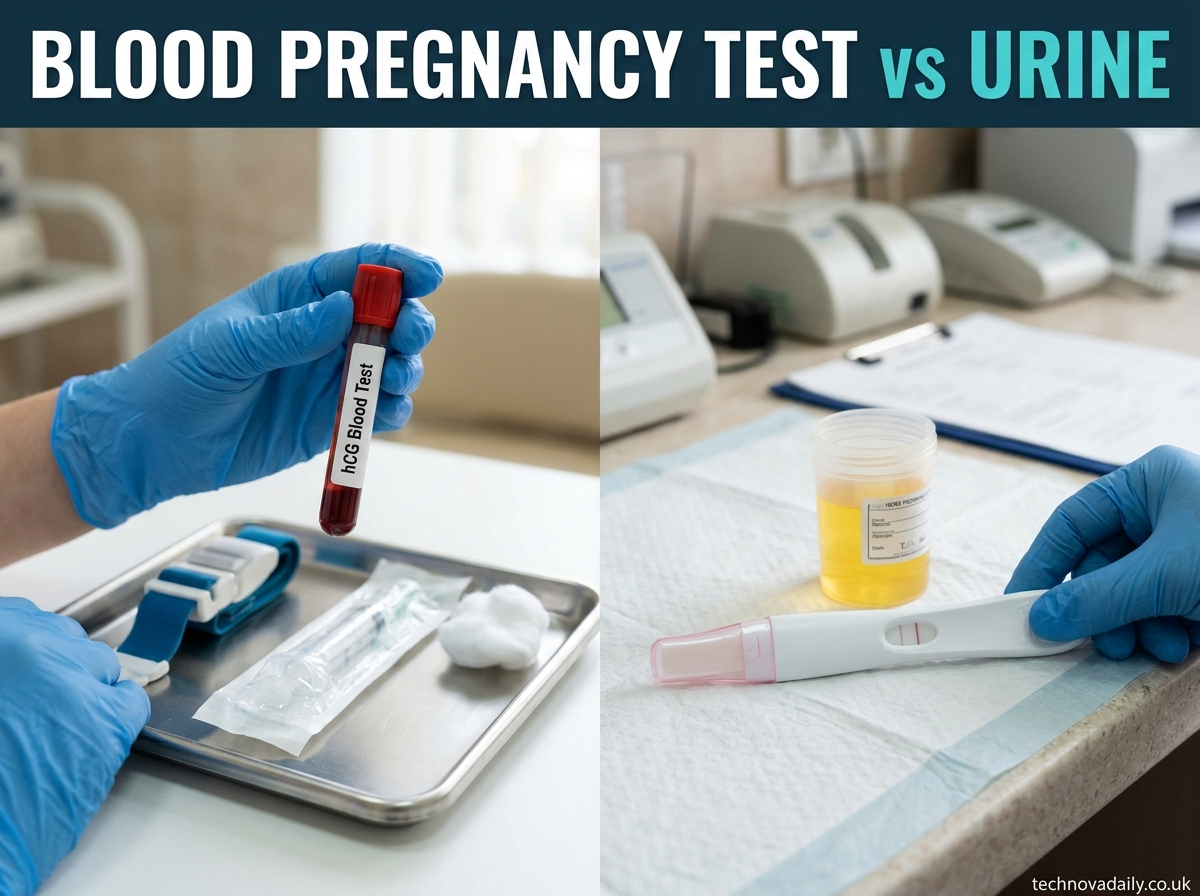
Quick answer: A blood pregnancy test detects pregnancy earlier, about 6 to 8 days after ovulation, because it can pick up very small amounts of the hormone hCG. A urine test is more convenient and is about 99% accurate when taken on or after the day of your missed period. If your result is unclear, your cycles are irregular, or you are having fertility treatment, a blood test is the better choice.
A late period, a faint line on a home test, or a negative result that does not match how you feel can leave you confused about what to do next. This guide compares blood and urine pregnancy tests side by side, so you can choose the right one and understand what your result means.
Blood vs Urine Pregnancy Test: Quick Comparison
| Factor | Urine Test | Blood Test |
|---|---|---|
| Earliest detection | Around the day of your missed period (some tests a few days earlier) | About 6 to 8 days after ovulation |
| Accuracy | About 99% when used correctly, after a missed period | Most sensitive; detects very low hCG levels |
| Result time | 1 to 5 minutes | A few hours to 1 to 2 days |
| Cost | Low | Higher (lab fee, sometimes a doctor’s visit) |
| Where it is done | At home | Lab or clinic |
| What it tells you | Yes or no (hCG present) | Yes or no, or the exact hCG level |
How Do Pregnancy Tests Work?
Both tests look for the same thing: human chorionic gonadotropin (hCG), a hormone made by the cells that will become the placenta. hCG starts to be released after the fertilized egg implants in the uterus, usually 6 to 12 days after ovulation.
After implantation, hCG rises quickly, roughly doubling every 48 to 72 hours in early pregnancy. It appears in the blood first and in the urine a little later, which is why a blood test can detect pregnancy sooner.
What Is a Urine Pregnancy Test?
A urine pregnancy test is the home test sold in pharmacies. You either hold a test strip in your urine stream or dip it in a collected sample, then wait a few minutes for a line, symbol, or digital result.
When to take it: For the most reliable result, test on or after the first day of your missed period. Some brands claim detection 3 to 5 days earlier, but results that early are less dependable. First-morning urine is best because it is more concentrated.
Pros
- Private, fast, and available without a prescription
- Inexpensive
- Very accurate when used after a missed period and by the instructions
Cons
- Less sensitive than a blood test, so it can miss very early pregnancy
- Can give a false negative if you test too early or your urine is diluted
- Cannot tell you the exact hCG level
Why a Urine Test Can Be Negative When You Are Pregnant
- Testing too early, before hCG has reached detectable levels
- Drinking a lot of fluids, which dilutes the urine
- Misreading or not following the timing instructions
- Rarely, very high hCG can overwhelm the test (called the hook effect)
What Is a Blood Pregnancy Test?
A blood pregnancy test measures hCG in a sample of blood drawn from a vein. It is done at a lab or clinic and is usually ordered by a doctor. There are two types.
Qualitative hCG Test (Yes or No)
This test only confirms whether hCG is present in your blood. It is similar to a urine test in what it tells you, but it can detect pregnancy earlier.
Quantitative hCG Test (Beta hCG)
This test measures the exact amount of hCG in your blood, reported in mIU/mL. Because a single number matters less than how it changes, doctors often repeat it 48 hours later to see whether levels are rising as expected. It can detect very small amounts, often as low as 1 to 5 mIU/mL.
Pros
- Detects pregnancy earlier than a urine test
- Can measure the exact hCG level
- Helps monitor early pregnancy, fertility treatment, and possible complications
Cons
- Costs more and requires a visit to a lab or clinic
- Results can take hours to a couple of days
- A single result does not tell the whole story; trends over time matter
Blood vs Urine: Head-to-Head
Which Is More Accurate?
Blood tests are more sensitive, meaning they detect lower hCG levels. Urine tests are still about 99% accurate when taken after a missed period and used correctly. The difference matters mainly in the first days after implantation, when hCG is very low.
Which Detects Pregnancy Earlier?
A blood test, by a few days. It can often detect pregnancy about 6 to 8 days after ovulation, while most urine tests need hCG to reach roughly 20 to 25 mIU/mL, which typically happens around the time of a missed period.
Which Is Faster and Cheaper?
Urine tests win on both. You get a result in minutes at home for a small cost. Blood tests take longer and cost more because of lab processing and sometimes a consultation.
When Should You Choose a Blood Test?
A urine test is enough for most people. A blood test is the better choice if:
- You have irregular cycles and do not know when your period is due
- You are having IVF or other fertility treatment and need precise, early confirmation
- You have symptoms of a possible ectopic pregnancy or miscarriage, such as one-sided pelvic pain, heavy bleeding, or dizziness. Seek medical care urgently if you have these
- Your doctor needs to track hCG levels over several days
- Home tests keep giving unclear or conflicting results
- You want confirmation as early as possible for medical reasons
Can You Trust a Home Pregnancy Test?
Yes, if you use it correctly. Follow these steps for the best result:
- Check the expiry date on the package.
- Test with first-morning urine, ideally on or after the day of your missed period.
- Follow the timing instructions exactly. Reading the result too late can show a false line.
- If the result is negative but your period does not arrive, retest after 3 to 7 days.
- See a doctor if you get a positive result, repeated negatives with a missed period, or any pain or heavy bleeding.
Understanding Your Results
Positive: hCG was detected. Book an appointment with a doctor to confirm the pregnancy and start prenatal care. False positives are uncommon but can happen with certain fertility medications or very early pregnancy loss.
Negative: No hCG was detected, or the level is too low for the test. If your period is still late, retest in a few days or ask for a blood test.
Faint line: A faint line usually means hCG is present at a low level. It most often means very early pregnancy, so retest in 48 hours; the line should get darker if the pregnancy is progressing. A faint line that never darkens, or is followed by bleeding, can indicate an early pregnancy loss (sometimes called a chemical pregnancy). Talk to your doctor.
Blood test numbers (general guide): Many labs treat a result below 5 mIU/mL as negative and above 25 mIU/mL as positive, with values in between needing a repeat test. Reference ranges differ between labs, so always follow your doctor’s interpretation.
Frequently Asked Questions
Can a blood pregnancy test be wrong?
Yes, but it is rare. Errors can come from testing extremely early, lab mix-ups, certain medications containing hCG, or rare medical conditions that raise hCG. If a result does not match your symptoms, your doctor may repeat the test.
Is a blood pregnancy test 100% accurate?
No test is 100% accurate, but quantitative blood tests come very close. They detect very low hCG levels and are considered the most reliable way to confirm early pregnancy. Repeating the test after 48 hours makes the picture even clearer.
How soon after intercourse can I take a blood test?
Pregnancy cannot be detected until the embryo implants, which happens about 6 to 12 days after ovulation. A blood test may detect it 7 to 12 days after conception. Testing earlier than that will likely show a negative result even if conception occurred.
Why is my urine test negative but my blood test positive?
Blood tests are more sensitive and detect hCG before it reaches the level a urine test needs. If you tested early or your urine was diluted, the urine test may miss a pregnancy that a blood test finds. Retesting a few days later usually shows a positive urine result.
Do I need a blood test to confirm a positive home test?
Not always, since a positive home test is very reliable. Still, you should see a doctor to confirm the pregnancy and plan prenatal care. A blood test is more likely if you have pain, bleeding, a history of ectopic pregnancy, or fertility treatment.
Conclusion
Blood tests find pregnancy earlier and can measure hCG precisely, while urine tests are quick, private, and highly accurate from the day of your missed period. For most people, a urine test is the right first step. Choose a blood test when you need earlier or more detailed results, or when your doctor recommends it.
