



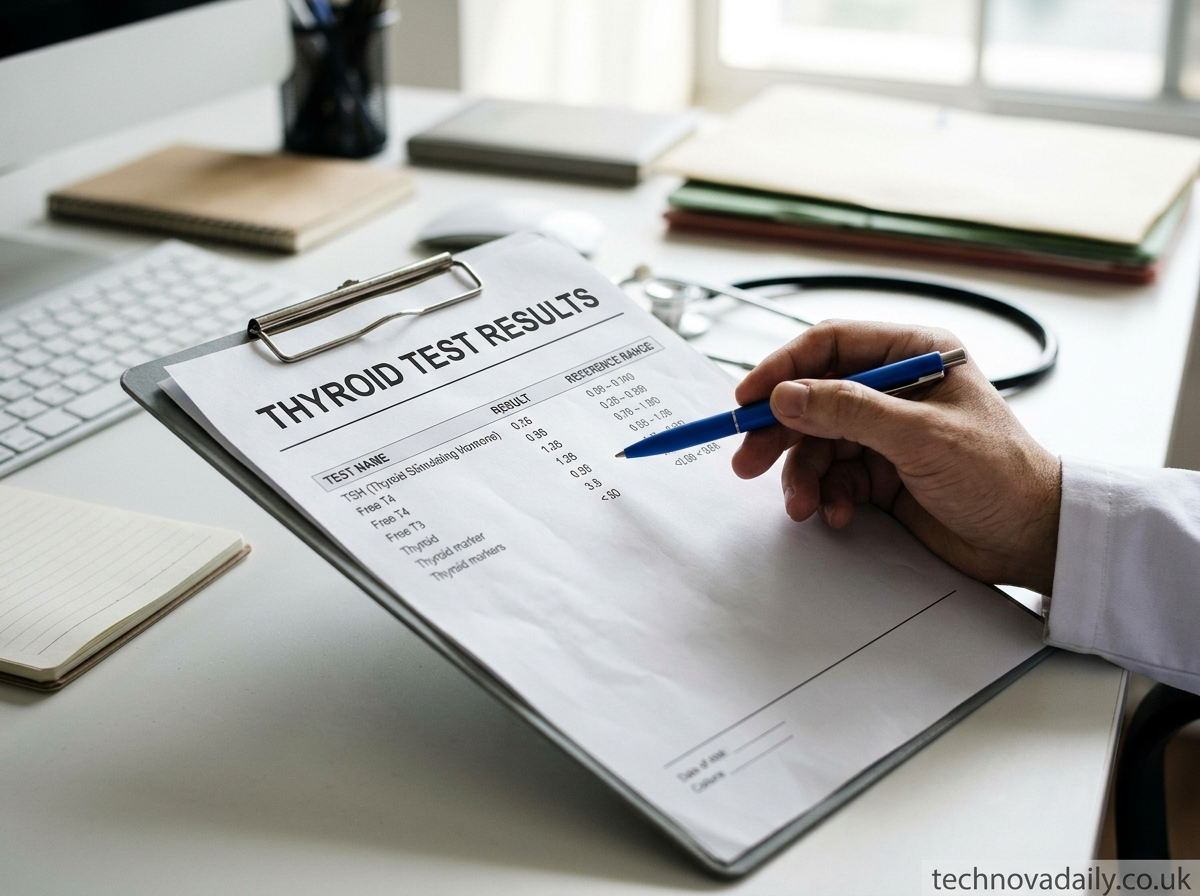
If you are holding a thyroid report and the numbers for TSH, T3 and T4 make no sense, this guide is for you. Thyroid test results show how much thyroid hormone is in your blood, which tells you whether your thyroid gland is working normally, is overactive (hyperthyroidism) or is underactive (hypothyroidism). Below, we explain normal ranges for TSH, Free T4, Free T3 and thyroid antibodies, what high and low values mean, and what to do next if your results are abnormal.
Important: This information is for education only. Your doctor makes the final interpretation based on your symptoms, medical history and your lab’s reference range.
Quick Answer: Thyroid Test Results at a Glance
| Test | Typical Normal Range | If High | If Low |
|---|---|---|---|
| TSH | 0.4 – 4.0 mIU/L | Usually hypothyroidism (underactive thyroid) | Usually hyperthyroidism (overactive thyroid) |
| Free T4 | 0.8 – 1.8 ng/dL | Points to hyperthyroidism | Points to hypothyroidism |
| Free T3 | 2.3 – 4.2 pg/mL | Points to hyperthyroidism | Underactive thyroid or illness |
Ranges differ slightly between labs. Always compare your numbers with the reference range printed on your own report.
A simple rule to remember: TSH moves in the opposite direction to thyroid hormones (T3, T4). High TSH with low T4 means a sluggish thyroid. Low TSH with high T4 means a fast one.
What Is a Thyroid Test?
A thyroid test is a blood test that checks how well your thyroid gland is working. This butterfly-shaped gland in your neck makes hormones that control metabolism, heart rate, body temperature and energy.
Doctors usually order several tests together, called a thyroid profile. It includes TSH, T3 and T4. Antibody tests are added when needed.
Who Should Get a Thyroid Test?
Your doctor may recommend a test if you have:
- Unexplained tiredness or sluggishness
- Sudden weight gain or weight loss
- Feeling too cold or too hot
- Hair loss and dry skin
- Constipation or loose stools
- A very fast or very slow heartbeat
- Mood swings, anxiety or low mood
- Irregular periods or difficulty getting pregnant
- Swelling in the neck (goiter)
Testing matters more for women (especially after age 35 and during pregnancy), people with a family history of thyroid disease, and people with diabetes or other autoimmune conditions.
How Do You Read Thyroid Test Results?
To read a thyroid report, look at TSH first, then compare it with Free T4 and Free T3. The combination of these three values shows what kind of thyroid problem, if any, you have.
TSH (Thyroid-Stimulating Hormone)
TSH is made by the pituitary gland in your brain. It tells the thyroid how much hormone to produce, which is why TSH is the first and most important screening test.
- Normal range: roughly 0.4 – 4.0 mIU/L (some labs use 0.5 – 5.0)
- High TSH: the thyroid is making too little hormone, so the brain sends a stronger signal
- Low TSH: the thyroid is making too much hormone, so the brain turns the signal down
Free T4 (FT4)
Free T4 is the main hormone made by the thyroid, measured in its unbound form that your cells can actually use. It shows how much hormone your thyroid is really producing.
- Normal range: roughly 0.8 – 1.8 ng/dL
- High FT4: suggests hyperthyroidism
- Low FT4: suggests hypothyroidism
Free T4 is generally more reliable than total T4, because total T4 is affected more by medicines and pregnancy.
Free T3 (FT3)
Free T3 is the more active thyroid hormone, which the body converts from T4. It is usually tested when TSH is low or hyperthyroidism is suspected.
- Normal range: roughly 2.3 – 4.2 pg/mL
- High FT3: hyperthyroidism, especially Graves’ disease
- Low FT3: can occur in underactive thyroid, prolonged illness or starvation
Thyroid Antibodies (Anti-TPO and Anti-TG)
Thyroid antibody tests show whether your immune system is mistakenly attacking your own thyroid. They help diagnose autoimmune thyroid diseases such as Hashimoto’s and Graves’.
- Anti-TPO (thyroid peroxidase antibodies): a high level often points to Hashimoto’s thyroiditis. Below about 35 IU/mL is usually considered normal, but this varies by lab.
- Anti-TG (anti-thyroglobulin): can also be raised in autoimmune thyroid disease.
- TRAb / TSI: used to confirm Graves’ disease in hyperthyroidism.
Positive antibodies do not mean your thyroid is failing right now. They signal a higher risk of future thyroid problems, so regular monitoring is important.
Thyroid Test Results Chart
| Test | Normal | High | Low |
|---|---|---|---|
| TSH | 0.4 – 4.0 mIU/L | Hypothyroidism | Hyperthyroidism |
| Free T4 | 0.8 – 1.8 ng/dL | Hyperthyroidism | Hypothyroidism |
| Free T3 | 2.3 – 4.2 pg/mL | Hyperthyroidism | Hypothyroidism or illness |
| Total T4 | 5 – 12 µg/dL | Hyperthyroidism | Hypothyroidism |
| Total T3 | 80 – 200 ng/dL | Hyperthyroidism | Hypothyroidism |
| Anti-TPO | Below 35 IU/mL | Autoimmune thyroid disease | Usually not a concern |
These ranges are approximate. Each lab’s equipment and method gives slightly different reference ranges, so treat the range on your own report as the final one.
What Does a High TSH Mean?
A high TSH usually means your thyroid is producing too little hormone, a condition called hypothyroidism. Your brain raises TSH to push the thyroid to work harder.
Common Symptoms of High TSH
- Fatigue and excessive sleepiness
- Weight gain
- Feeling cold
- Constipation
- Dry skin and hair loss
- Hoarse voice
- Low mood and poor memory
- Heavy or irregular periods
Common Causes of High TSH
- Hashimoto’s thyroiditis: the most common cause, an autoimmune condition
- Iodine deficiency
- Thyroid surgery or radioactive iodine treatment
- Certain medicines (such as lithium and amiodarone)
- Inflammation of the thyroid (thyroiditis)
If TSH is only mildly high (for example, 4.5 to 10 mIU/L) and Free T4 is normal, this is called subclinical hypothyroidism. Doctors often do not start medicine right away and instead repeat the test after 6 to 12 weeks.
What Does a Low TSH Mean?
A low TSH usually means your thyroid is producing too much hormone, a condition called hyperthyroidism. Excess hormone in the body makes the brain turn TSH down.
Common Symptoms of Low TSH
- Fast or pounding heartbeat (palpitations)
- Weight loss despite a good appetite
- Heat intolerance and sweating
- Trembling hands
- Anxiety and irritability
- Trouble sleeping
- Frequent or loose stools
- Bulging eyes (in Graves’ disease)
Common Causes of Low TSH
- Graves’ disease: an autoimmune condition and the most common cause
- Thyroid nodules (toxic nodular goiter)
- Thyroiditis (inflamed thyroid)
- Too high a dose of thyroid medicine (levothyroxine)
- A slightly low TSH can also occur in the first trimester of pregnancy
What Do Different Combinations of Results Mean?
Looking at TSH and T4 together matters more than any single number. The table below shows the most common patterns.
| TSH | Free T4 | Meaning |
|---|---|---|
| High | Low | Overt hypothyroidism (clearly underactive thyroid) |
| High | Normal | Subclinical hypothyroidism |
| Low | High | Overt hyperthyroidism (clearly overactive thyroid) |
| Low | Normal | Subclinical hyperthyroidism |
| Normal | Normal | Thyroid is usually working normally |
| Low or normal | Low | Possible pituitary or brain-related cause (less common, see a specialist) |
Can You Have Symptoms Even With Normal Thyroid Results?
Yes, it is possible. A normal report does not always explain every symptom, and other conditions often play a role.
A reference range covers about 95% of healthy people. Some people feel unwell at the upper end of the range (for example, a TSH of 3.5 to 4.0), especially if their Anti-TPO is positive.
Other conditions that mimic thyroid symptoms:
- Low iron or ferritin (very common in women)
- Vitamin D and vitamin B12 deficiency
- Anemia
- Diabetes or insulin resistance
- Poor sleep and stress
- PCOS
Ask your doctor to check a blood count, ferritin, vitamin D and B12 along with your thyroid tests. Do not start treatment on your own in pursuit of an optimal range.
What Can Affect Thyroid Test Results?
Several things can change your thyroid numbers, so tell your doctor and the lab about every medicine and supplement you take before testing.
- Biotin (vitamin B7) supplements: common in hair and nail products, and they can give false TSH, T3 and T4 results on some lab methods. Your doctor may ask you to stop them 2 to 3 days before the test.
- Pregnancy: hormone levels change, and pregnancy has its own reference ranges.
- Medicines: steroids, lithium, amiodarone, dopamine and some heart and psychiatric drugs can interfere.
- Timing of thyroid medicine: if you already take levothyroxine, tests are usually done before your morning dose. Check with your doctor.
- Time of day: TSH is higher at night and early morning and lower in the afternoon. Test at the same time for follow-ups.
- Serious illness or infection: numbers can shift temporarily during recovery.
- Fasting: usually not needed for thyroid tests, but follow the lab’s instructions if other tests such as blood sugar or cholesterol are included.
What Should You Do After an Abnormal Thyroid Result?
If your thyroid report is abnormal, do not panic. Repeat the test and see a doctor or endocrinologist, because most thyroid conditions are treatable.
- Repeat the test: a mildly abnormal TSH often returns to normal or is confirmed after 6 to 12 weeks.
- See a doctor or endocrinologist: bring your report, symptoms and family history.
- Further tests: antibodies, a thyroid ultrasound or a thyroid scan, if needed.
- Treatment:
- Hypothyroidism is usually treated with a daily levothyroxine tablet.
- Hyperthyroidism may be treated with anti-thyroid medicines, radioactive iodine or, sometimes, surgery.
- Follow-up: TSH is usually rechecked every 6 to 8 weeks until the dose is right, then once or twice a year.
Do not start or stop thyroid medicine on your own. A wrong dose can affect your heart and bones.
Red Flags: When to See a Doctor or Go to Emergency Right Away
- Chest pain or a very fast, irregular heartbeat
- Difficulty breathing
- High fever with agitation or confusion
- Extreme drowsiness or loss of consciousness
- Rapidly growing neck swelling with trouble swallowing or breathing
- An abnormal thyroid result during pregnancy
How Often Should You Get a Thyroid Test?
If you have no symptoms and no risk factors, routine testing is not needed. Get tested if you have symptoms, a family history of thyroid disease, or your doctor recommends it.
- You have symptoms: test as soon as possible
- You already take thyroid medicine: 6 to 8 weeks after any dose change, then once or twice a year when stable
- Planning pregnancy or pregnant: as advised by your doctor, early on and again if needed
- Family history or autoimmune disease: once a year, or as your doctor advises
- Newborn babies: screened in hospital shortly after birth
FAQs: Thyroid Test Results
What is a normal TSH level?
For adults, a normal TSH is usually 0.4 to 4.0 mIU/L. Some labs use 0.5 to 5.0. Always check the reference range on your own report.
Do I need to fast for a thyroid test?
Usually not. TSH, T3 and T4 tests do not require fasting. Ask your doctor about biotin supplements and your thyroid medicine, and follow the lab’s instructions if other tests are included.
What should I do if my TSH is high?
Check your Free T4, repeat the test, and see a doctor or endocrinologist. A slightly high TSH may only need monitoring, but a much higher level or clear symptoms may need levothyroxine.
Can thyroid test results change from day to day?
Yes, slightly. TSH can vary with time of day, illness, medicines, supplements and poor sleep. For follow-up, test at the same time of day and at the same lab if possible.
What is a normal TSH during pregnancy?
Pregnancy has different reference ranges, and TSH is naturally lower in the first trimester. Doctors usually use trimester-specific or pregnancy-specific lab ranges. Always have your thyroid report reviewed by your gynecologist or endocrinologist.
How much does a thyroid test cost in Pakistan?
A TSH-only test in Pakistan typically starts at a few hundred rupees, while a full thyroid profile (TSH, T3, T4) with antibodies costs more. Prices vary by city and lab, so confirm with your nearest lab. (Editor note: update current rates for your target city before publishing.)
Conclusion: Key Takeaways
- TSH is the first test: a high TSH usually means an underactive thyroid, and a low TSH usually means an overactive one.
- Never judge by one number: read TSH, Free T4 and Free T3 together and match them with your symptoms.
- An abnormal report is not a final diagnosis: repeat the test and talk to a doctor. Most thyroid conditions can be controlled with treatment.
If your thyroid report is abnormal or your symptoms continue, book an appointment with a qualified doctor or endocrinologist today.
Disclaimer: This article is for information only and is not a substitute for medical advice. Talk to your doctor before starting or stopping any treatment.
Sources / References
- American Thyroid Association (thyroid.org)
- National Institute of Diabetes and Digestive and Kidney Diseases (NIDDK), NIH
- Mayo Clinic: Thyroid tests
- NHS UK: Thyroid function tests
