



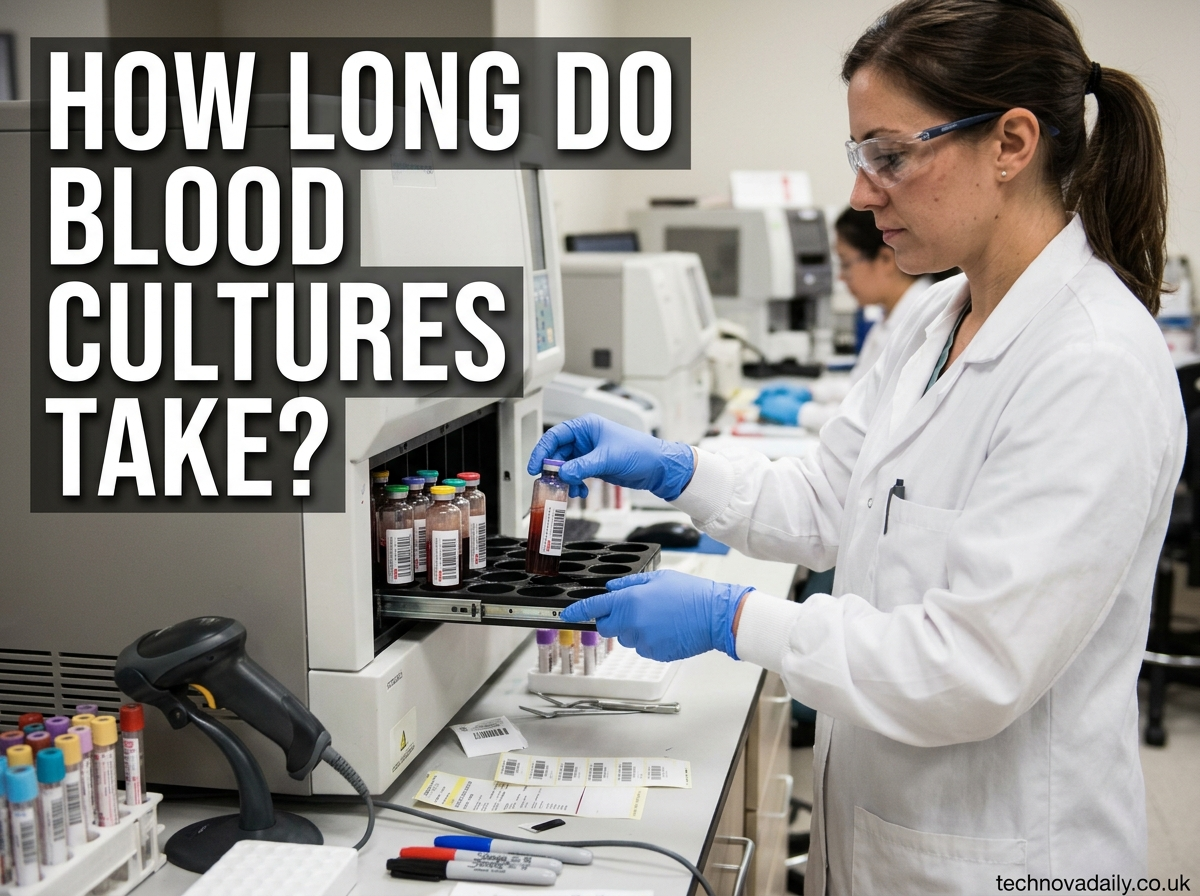
Blood culture tests usually take about 5 days for a final negative result, although preliminary information may be available within 24 to 48 hours. If bacteria or fungi grow in the sample, the laboratory may report a positive result sooner. Further testing can take additional time to identify the organism and determine which medicines may work against it.
The exact waiting time depends on the type of microorganism, the laboratory’s procedures, and the tests needed after growth is detected. Blood cultures help doctors find infections in the bloodstream and make treatment decisions, especially when a serious infection such as sepsis is suspected.
1. How Long Do Blood Cultures Take?
Most routine blood cultures are monitored for around five days before the laboratory reports a final negative result. However, some samples need longer observation when a particular infection is suspected or the laboratory follows a different testing protocol.
Preliminary updates may be available during the first 24 to 48 hours. If the sample shows microbial growth, the laboratory can notify the healthcare team and begin further testing. Identifying the exact organism and checking its response to antibiotics may extend the process beyond the first positive report.
A longer wait does not automatically mean that you have an infection. Likewise, an early report showing no growth does not always rule out an infection. Your doctor will interpret the results alongside your symptoms, medical history, and other laboratory findings.
2. Blood Culture Test Results Timeline
Preliminary Blood Culture Results
Preliminary information may become available within the first 24 to 48 hours, depending on the sample and laboratory process. During this period, the laboratory monitors the blood culture bottles for signs of microbial growth. If the system detects growth, staff can begin investigating the possible cause.
An early report may show that no growth has been detected so far. This is not always the same as a final negative result because some microorganisms take longer to grow. Your healthcare team may receive updates as the laboratory completes more testing.
Positive Blood Culture Results
A blood culture becomes positive when the laboratory detects signs of microbial growth. Some positive cultures are detected within hours, while others take longer. The timing depends on the organism, the amount present in the sample, and other factors.
After growth is detected, the laboratory works to identify the microorganism. Additional testing may determine which antibiotics are likely to be effective. Doctors may begin or adjust treatment before every test is complete if the patient’s condition requires prompt action.
Final Blood Culture Results
A final negative report is commonly available after about five days of routine incubation, provided no growth has been detected and no extended testing is needed. Some suspected infections require a longer period of monitoring.
A final positive report may also take time to complete because identifying the organism and performing antibiotic susceptibility testing are separate steps. Ask your healthcare provider whether the result you received is preliminary or final, as this distinction can help you understand what the report means.
3. How Long Do Positive Blood Cultures Take?
Positive blood cultures may be detected within the first day, but there is no single timeline for every infection. Some bacteria grow quickly, while other organisms take longer to become detectable. The laboratory may contact the treating team as soon as a potentially important result appears.
Once growth is detected, the next step is to determine which organism is present. This process may take another day or longer, depending on the laboratory’s methods and the organism involved. Some laboratories use rapid identification methods that can provide information sooner.
Antibiotic susceptibility testing may require additional time. This testing helps determine which medicines are likely to work against the organism. Doctors do not always wait for the complete report before starting treatment, particularly when a patient has signs of a serious bloodstream infection. The treatment plan may be updated when more information becomes available.
4. How Long Do Negative Blood Cultures Take?
A negative blood culture means that the laboratory did not detect microbial growth in the sample during the testing period. A preliminary negative result may appear within 24 to 48 hours, but routine cultures are often monitored for around five days before a final negative report is issued.
The time between preliminary and final results allows the laboratory to detect organisms that grow more slowly. If no growth appears during the required incubation period, the laboratory may report the culture as negative. The precise timing depends on local laboratory procedures and whether further testing is needed.
A negative result does not completely exclude a bloodstream infection. Antibiotics taken before the sample was collected, a small number of microorganisms in the blood, or other testing limitations may affect the result. If symptoms continue or worsen, your healthcare provider may consider other tests or repeat blood cultures when appropriate.
5. Why Do Blood Culture Results Take So Long?
Blood cultures take time because microorganisms must grow to a detectable level before the laboratory can study them. Different bacteria and fungi grow at different rates, so a sample that remains negative during the first day may still need further monitoring.
Identifying the organism is another part of the process. After growth is detected, laboratory staff may perform tests to determine whether bacteria or fungi are present and which type is responsible. This information helps the medical team understand the possible source of infection and choose suitable treatment.
Antibiotic susceptibility testing can add more time because the laboratory needs to assess how the organism responds to specific medicines. Extended incubation or specialized tests may also be needed in selected cases. These steps help provide information that a simple early report cannot offer.
6. What Does a Blood Culture Test Detect?
A blood culture test checks for bacteria and certain fungi in the bloodstream. A healthcare professional collects blood into specially designed culture bottles, which are then placed in a laboratory system that monitors for microbial growth.
Doctors may order blood cultures when a person has symptoms suggesting a serious infection, such as fever, chills, a fast heart rate, or a sudden decline in their condition. The test can help identify organisms responsible for bloodstream infections and support the diagnosis and treatment of sepsis.
Blood cultures are different from a complete blood count (CBC). A CBC measures blood cells, including white blood cells, while a blood culture attempts to grow and identify microorganisms. The tests may be ordered together because they provide different types of information about a patient’s condition.
7. What Happens After a Positive Blood Culture?
When a blood culture becomes positive, the laboratory informs the healthcare team according to its reporting procedures. The medical team reviews the result along with the patient’s symptoms, examination findings, and other test results. If a serious infection is suspected, treatment may begin or change before the full laboratory report is available.
The laboratory then works to identify the organism. Depending on the findings, it may perform antibiotic susceptibility testing to show which medicines are likely to be effective. Doctors use this information to select or adjust treatment based on the infection, the patient’s condition, and any other relevant medical factors.
Not every positive result means that a true bloodstream infection is present. Sometimes, microorganisms enter the sample from the skin during collection, causing contamination. Clinicians consider the organism identified, how many culture bottles or sets are positive, the collection method, and the patient’s symptoms before deciding what the result means.
8. Can Antibiotics Affect Blood Culture Results?
Yes. Antibiotics taken before blood is collected can reduce the chance of detecting bacteria in a blood culture. The medicine may limit microbial growth, which can make the test less likely to identify the organism responsible for an infection.
For this reason, healthcare professionals generally try to collect blood cultures before starting antibiotics when it is safe and practical to do so. Depending on the situation, more than one culture set may be collected to improve the chance of detecting microorganisms and help interpret the findings.
However, blood collection should not delay urgent treatment when sepsis or another serious infection is suspected. If you have already taken antibiotics, tell your healthcare provider which medicine you used and when you took it. Do not stop prescribed antibiotics or change your dose without medical advice.
9. When Should You Be Concerned About Waiting for Blood Culture Results?
Waiting several days for a final blood culture report is common and does not necessarily mean that the laboratory has found a problem. The sample may simply need the full incubation period before a final result can be issued. If your report remains pending beyond the expected time, contact the healthcare provider or laboratory responsible for your test.
You should not rely on the culture result alone to judge how serious an illness is. A person can have a serious infection even when an early culture has not detected growth. Doctors consider symptoms, examination findings, vital signs, and other test results when deciding whether further assessment or treatment is needed.
Seek emergency medical care if you develop confusion, difficulty breathing, fainting, severe weakness, or rapidly worsening symptoms. These can be warning signs of a serious illness, including sepsis. Do not wait for your blood culture results if you feel seriously unwell.
10. Frequently Asked Questions About Blood Culture Results
Can blood culture results come back in 24 hours?
Yes, some blood cultures may show positive growth within 24 hours, and preliminary information may be available during this period. However, many samples need more time, and an early report showing no growth is not usually the final result.
Do blood cultures take 3 or 5 days?
Routine blood cultures are commonly monitored for about five days before a final negative result is reported. A positive result may appear sooner, but organism identification and antibiotic susceptibility testing can take additional time.
How long does it take to identify bacteria in a blood culture?
The timing varies. After growth is detected, identification may take several hours to a few days, depending on the organism and the laboratory’s methods. Additional tests may be needed before the final report is complete.
Does no growth after 48 hours mean there is no infection?
No. It means that the laboratory has not detected growth so far. Some microorganisms take longer to grow, and antibiotics taken before collection may affect the result. A healthcare professional should interpret the finding in the context of your symptoms and other tests.
Why are my blood culture results still pending after 5 days?
Possible reasons include extended incubation, additional testing, laboratory procedures, or delays in finalizing the report. Contact your healthcare provider or laboratory to find out whether the sample is still being monitored or whether the report is awaiting completion.
Can a blood culture be positive if I am taking antibiotics?
Yes. Antibiotics can lower the chance of detecting microorganisms, but they do not always prevent a culture from becoming positive. The result depends on several factors, including the organism, the medicine, and when the blood sample was collected.
11. Conclusion
Blood cultures commonly take around five days for a final negative result, although preliminary updates may be available within 24 to 48 hours. Positive results can appear sooner, but identifying the organism and testing its response to antibiotics may require extra time.
The exact timeline depends on the microorganism, the laboratory’s procedures, and the need for further testing. A preliminary negative result does not always rule out infection, and a positive result must be interpreted in context. If you are waiting for your report, your healthcare provider can explain its status and what the findings mean for your care.
